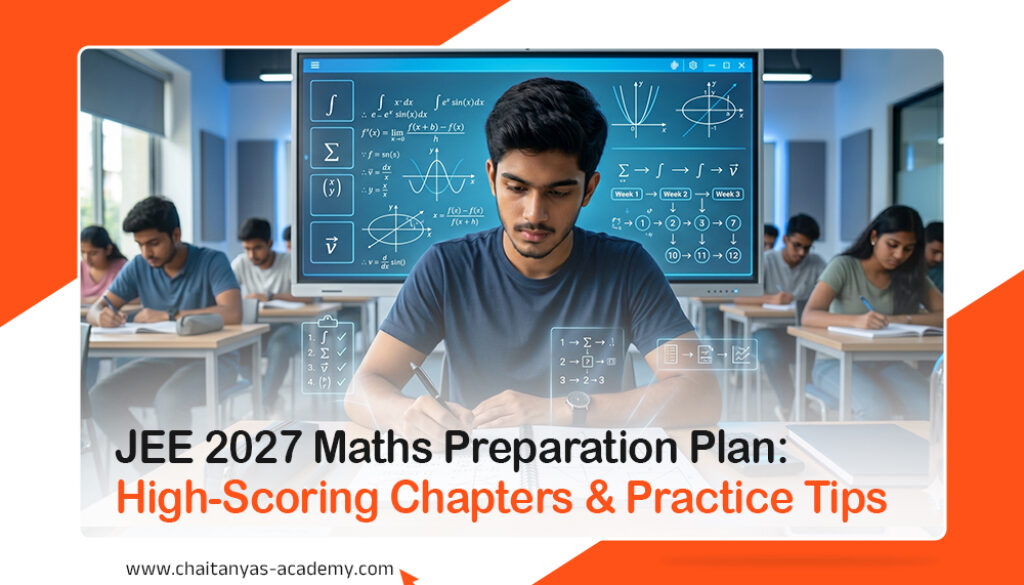
JEE 2027 Maths Preparation Plan: High-Scoring Chapters & Practice Tips
Mathematics is one of the most important subjects for engineering aspirants. It is the rank-booster subject in the exam if you prepared for it the right way. Unlike Physics and Chemistry, Maths demands consistent practice, speed, and clarity of concepts.
If you’re targeting JEE 2027, this guide will help you with a clear preparation plan, high-scoring chapters, and smart practice strategies
Why Maths is Crucial in JEE
Maths is the key subject in the JEE exam. You can improve your JEE score in mathematics by mastering speed and accuracy.
* High scoring with practice
* Improves overall rank significantly
* Helps in time management if mastered
High-Scoring Chapters in JEE Maths
The high-weightage chapters in maths for the JEE exam based on the previous year trend are as follows:
Calculus (Most Important)
* Limits, Continuity & Differentiability
* Application of Derivatives
* Integrals & Area Under Curve
* Differential Equations
Weightage: Highest in JEE
Focus on concepts + application-based problems in calculus to solve the questions easily with accuracy.
Algebra
* Quadratic Equations
* Sequences & Series
* Binomial Theorem
* Complex Numbers
Strong basics in algebra help with easier problem-solving. Focus on the fundamentals of topics to boost your understanding.
Coordinate Geometry
* Straight Lines
* Circles
* Parabola, Ellipse, Hyperbola
Visual understanding helps a lot in solving the questions around the topic.
Trigonometry
* Identities
* Equations
* Inverse Trigonometric Functions
Practice-based + formula-heavy questions are good to practice and master the topic.
Vector & 3D Geometry
* Direction ratios
* Planes & lines
Easy to moderate scoring section with high-scoring questions, and consumes less time
Step-by-Step Maths Preparation Plan
Phase 1: Build Concepts (First 6–8 Months)
During the first few months of the JEE preparation, you should understand the basics so that the correlated complex topics become easier to understand. The key focus during this phase is as follows:
* Focus on understanding theory
* Solve basic to moderate problems
* Don’t skip fundamentals
Phase 2: Practice & Application (Next 8–10 Months)
Once you master the basic topics, it’s time to learn the application of these concepts because JEE checks your analytical thinking and problem solving skills. Therefore, you should:
* Solve higher-level problems
* Attempt mixed question sets
* Start timed practice
Phase 3: Revision & Mock Tests (Last 6 Months)
This is the last phase of the preparation. Though you should practice with the mock tests from the initial days of preparation, at this stage, full-length mock tests are important to solve and analyse.
* Revise all formulas
* Attempt full-length tests
* Analyze mistakes
How to do Daily Maths Practice for JEE Exam
* Solve 25–40 questions daily
* Mix easy + moderate + tough questions
* Focus on quality over quantity
* Revise formulas regularly
Smart Practice Tips
1. Don’t Memorize, Understand
Maths does not require memorization; you should understand the reason behind each concept and understand the derivation of the formula to easily solve application based problems or some tricky questions.
2. Maintain a Formula Notebook
Note down the important formulas and their derivations in a notebook to revise daily. A quick review of the formulas helps to remember them for a longer period.
3. Practice Previous Year Questions
Solve at least the last 10 years’ exam papers to learn the exam pattern, question trend and marking scheme. Identify the high-weightage topics and keep your preparation strategy around these topics for scoring good marks.
4. Focus on Weak Areas
Find your weakness after attempting the Mock tests. Seek guidance or help to clear your doubts instantly. Don’t avoid tough chapters; instead, break them into smaller chunks. Practice them more for a better understanding.
5. Time Yourself
Time management is one of the important factors for any exam preparation. Solving questions using the timer helps in improving your speed and accuracy.
6. Analyze Your Mistakes
Only solving questions will not work; analyse your test, make a mistake notebook, and revise errors regularly.
JEE Maths Detailed syllabus
| Chapter Name | Sub-topics |
| Set, Relations & Functions | Sets and their representation: Union, intersectionComplement of sets and their algebraic properties; Power setRelation, Type of relations, equivalence relationsFunctions: one-one, into and onto functions, the composition of functions |
| Complex Number & Quadratic Equation | Complex numbers as ordered pairs of reals, Representation of complex numbers in the form a + ib and their representation in a plane, Argand diagramAlgebra of complex number, modulus, and argument (or amplitude) of a complex numberQuadratic equations in real and complex number system and their solutions Relations between roots and coefficientNature of roots, the formation of quadratic equations with given roots |
| Matrices & Determinants | Matrices, Algebra of matrices, type of matricesDeterminants and matrices of order two and three, evaluation of determinants, area of triangles using determinantsAdjoint, and evaluation of inverse of a square matrix using determinantsTest of consistency and solution of simultaneous linear equations in two or three variables using matrices |
| Permutation & Combination | The fundamental principle of countingPermutation as an arrangement and combination as sectionMeaning of P (n, r) and C (n, r), simple applications |
| Binomial Theorem & Its Applications | Binomial theorem for a positive integral indexGeneral term and middle term, and simple applications |
| Sequence & Series | Arithmetic and Geometric progressionsInsertion of arithmetic, geometric means between two given numbers Relation between A.M and G.M |
| Limit, Continuity & Differentiability | Real–valued functions, algebra of functions, polynomials, rational, trigonometric, logarithmic, and exponential functions; Inverse function.Graphs of simple functions. Limits, continuity, and differentiability. Differentiation of the sum, difference, product, and quotient of two functions.Differentiation of trigonometric, inverse trigonometric, logarithmic, exponential, composite, and implicit functions; derivatives of order up to two.Applications of derivatives: Rate of change of quantities, monotonic-Increasing and decreasing functions, Maxima, and minima of functions of one variables |
| Integral Calculus | Integral as an antiderivative, Fundamental integral involving algebraic, trigonometric, exponential, and logarithmic functions. Integrations by substitution, by parts, and by partial functions. Integration using trigonometric identities. Evaluation of simple integrals of the type The fundamental theorem of calculus, properties of definite integrals. Evaluation of definite integrals, determining areas of the regions bounded by simple curves in standard form. |
| Differential Calculus | Ordinary differential equations, their order, and degreeThe solution of differential equation by the method of separation of variablesSolution of a homogeneous and linear differential equation of the type dydx+p(x)y=q(x) |
| Coordinate Geometry | Cartesian system of rectangular coordinates in a plane, distance formula, sections formula, locus, and its equation, the slope of a line, parallel and perpendicular lines, intercepts of a line on the coordinate axis.Straight line – Various forms of equations of a line, intersection of lines, angles between two lines, conditions for concurrence of three lines, the distance of a point from a line, Coordinate of the centroid, orthocentre, and circumcentre of a triangle.Circle, Conic Sections – A standard form of equations of a circle, the general form of the equation of a circle, its radius and central, equation of a circle when the endpoints of a diameter are given, Points of intersection of a line and a circle with the centre at the origin and sections of conics, equations of conic sections (parabola, ellipse, and hyperbola) in standard forms |
| Three Dimensional Geometry | Coordinates of a point in space, the distance between two points, section formula, Directions ratios, and direction cosines, and the angle between two intersecting lines. Equation of a line, Skew lines, the shortest distance between them, and its equation. |
| Vector Algebra | Vectors and scalars, the addition of vectors, components of a vector in two dimensions and three-dimensional space, Scalar, and vector products. |
| Statistics & Probability | Measures of dispersion; calculation of mean, median, mode of grouped and ungrouped data calculation of standard deviation, Variance, and mean deviation for grouped and ungrouped data.Probability: Probability of an event, addition, and multiplication theorems of probability, Baye’s theorem, probability distribution of a random variable |
Common Mistakes to Avoid
* Ignoring Maths due to fear
* Not practising daily
* Skipping revision
* Relying only on theory
* Not analyzing mistakes
Conclusion
Maths is one of the most crucial subjects for JEE aspirants. Students must focus on concepts and make a strong fundamental base, learn to find formulas with derivatives, solve questions using tricks and attempt mock tests. At Chaitanya Academy, we JEE & NEET Coaching Institute provide complete guidance to the students of class 11th & 12th, focusing on maths preparation and helping the JEE aspirants touch the success flag.
Frequently Asked Questions (FAQs)
What are the high-weightage topics for JEE Maths?
Answer: Important JEE Maths topics include Calculus, Algebra, Coordinate Geometry, Trigonometry, and Vectors. These chapters carry significant weightage in the exam.
How many questions are there in the Maths section of JEE?
Answer: The JEE Maths section generally contains 20 multiple-choice questions (MCQs) and 5 numerical value-based questions.
Is Class 11 Maths important for JEE?
Answer: Yes, Class 11 Maths is very important as it forms the foundation for Class 12 concepts. Many JEE questions are directly based on Class 11 chapters.
How to prepare for JEE Maths?
Answer: Start with NCERT for conceptual understanding, practice from books like RD Sharma, and solve mock tests and previous year papers to improve speed and accuracy.