
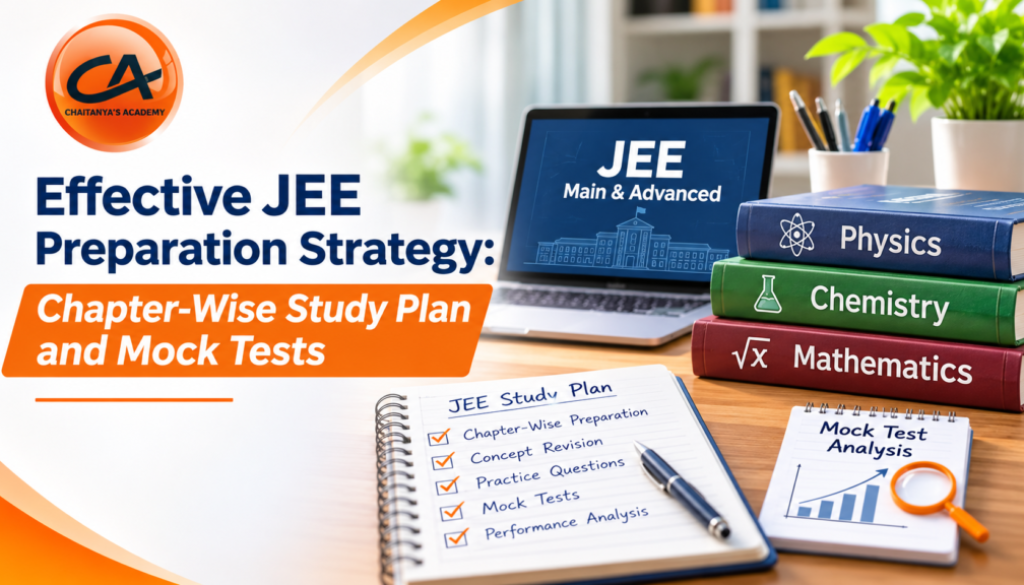
Effective JEE Preparation Strategy: Chapter-Wise Study Plan and Mock Tests
Preparing for JEE Main and JEE Advanced requires more than studying for long hours. Students need a well-planned JEE strategy that combines conceptual understanding, chapter-wise preparation, regular practice, and effective mock test analysis. With Physics, Chemistry, and Mathematics carrying equal marks, focusing on all subjects is important.
For Class 11 and 12 students, starting with a structured study plan can make JEE preparation more manageable. Chaitanya’s Academy focuses on helping students build strong subject fundamentals, practise systematically, and develop the right approach towards competitive examinations.
Understanding the JEE Exam Pattern
Before creating a preparation strategy, students should understand the requirements of both examinations.
JEE Main: Conducted by the National Testing Agency (NTA), for admission to NITs, IIITs, and other participating engineering institutions. Passing JEE Main also makes you eligible for the JEE Advanced exam.
JEE Advanced: This examination is conducted by one of the IITs for admission to IIT colleges across the nation.
How to Build an Effective JEE Strategy
An effective JEE preparation strategy should include realistic goals, a realistic timetable, and regular performance evaluation.
Set Realistic Study Goals
Divide your preparation into daily, weekly, and monthly targets. Instead of setting unachievable goals, set small goals and reward yourself for motivation. For example, your weekly targets could include completing one Physics chapter, revising an Organic Chemistry topic, and practising selected Mathematics problems.
Create a Daily and Weekly Study Timetable
A consistent timetable helps students manage school, coaching, and self-study. Allocate dedicated time to all three subjects and include short breaks to maintain concentration.
An illustrative daily schedule could be:
- Physics: 2 hours for concepts and numerical problems
- Chemistry: 2 hours for theory and question practice
- Mathematics: 2 hours for problem-solving
- Revision: 1 hour for previously studied topics
- Practice: 1 hour for mixed questions or mock test analysis
Balance Physics, Chemistry, and Mathematics
Avoid focusing excessively on one subject while neglecting others. Physics requires conceptual understanding and numerical practice, Chemistry demands regular theory revision and application, while Mathematics improves through consistent problem-solving. Identify your weaker subjects and allocate additional practice time without ignoring your stronger areas.
Chapter-Wise Preparation Strategy for JEE
Chapter-wise preparation allows students to cover the syllabus systematically and identify topics that need additional attention.
Physics: Focus on Concepts, Formulas and Numerical Practice
Physics requires a combination of theoretical understanding and application. Begin with fundamental concepts and understand the derivations, formulas, and their practical applications.
Focus on topics such as Mechanics, Thermodynamics, Current Electricity, Electrostatics, Optics, and Modern Physics. Solve basic questions first and gradually move towards advanced numerical problems.
Chemistry: Prepare Physical, Organic, and Inorganic Chemistry Separately
Chemistry preparation becomes easier when divided into three sections:
- Physical Chemistry: Focus on formulas, numerical calculations, and conceptual understanding. Practice topics such as Chemical Equilibrium, Thermodynamics, and Electrochemistry.
- Organic Chemistry: Understand reaction mechanisms, functional groups, and conversions. Build a strong foundation in General Organic Chemistry.
- Inorganic Chemistry: Pay attention to NCERT concepts, periodic trends, chemical bonding, and important reactions.
Mathematics: Develop Problem-Solving Skills
Mathematics requires consistent practice and conceptual clarity. Focus on topics such as Calculus, Coordinate Geometry, Algebra, Trigonometry, and Vectors.
Understand the basic approach before attempting difficult questions. Practise multiple question types and learn to identify the most efficient solving methods.
How to Prioritise Important Chapters
Use previous years’ JEE question papers and mock test analysis to understand frequently tested topics and question patterns.
However, avoid preparing only selected high-weightage chapters. Every part of the prescribed syllabus deserves appropriate attention. Prioritise topics based on their weightage, your conceptual understanding and the time required for preparation.
The Importance of Mock Tests in JEE Preparation
Mock tests are an essential part of JEE preparation because they help students understand examination conditions, manage time and evaluate their progress.
When Should Students Start Attempting Mock Tests?
Students can begin chapter-wise and topic-wise tests as soon as they complete individual chapters. Once they have covered a substantial portion of the syllabus, they should gradually introduce full-length mock tests.
How Frequently Should JEE Aspirants Take Mock Tests?
The frequency should depend on the preparation stage:
- Initial stage: Chapter-wise and topic-wise tests.
- Intermediate stage: Weekly or fortnightly tests.
- Final preparation stage: Regular full-length mock tests based on the examination pattern.
Remember, attempting tests is only one part of preparation. Analysing mistakes is equally important.
How to Analyse Mock Test Performance
After every test, evaluate your performance by identifying:
- Incorrect answers caused by conceptual gaps.
- Questions left unanswered due to time constraints.
- Calculation and silly mistakes.
- Topics that require additional revision.
- Questions that consumed too much time.
Common JEE Preparation Mistakes Students Should Avoid
Some common mistakes can affect preparation despite consistent effort:
- Studying without a proper timetable.
- Ignoring Class 11 concepts while preparing for Class 12.
- Depending entirely on coaching without self-study.
- Collecting too many books and study materials.
- Skipping mock test analysis.
- Neglecting revision and previous years’ questions.
How Chaitanya’s Academy Supports Structured JEE Preparation
Choosing the right academic guidance can make JEE preparation more organised. Chaitanya’s Academy supports students through structured JEE coaching for Class 11 and 12, subject-wise guidance and systematic academic preparation.
With guidance in Physics, Chemistry, and Mathematics, students can strengthen their fundamentals, practise important concepts, and work towards improving their problem-solving abilities.
Conclusion
A successful JEE preparation strategy depends on conceptual clarity, chapter-wise learning, consistent practice, and regular mock test analysis. Students should focus on understanding concepts rather than memorising solutions and continuously evaluate their progress.
With a balanced study timetable and the right academic guidance, Class 11 and 12 students can approach JEE Main and JEE Advanced with better preparation and confidence. Start planning early, practise consistently, and make every revision session count.
Frequently Asked Questions About JEE Preparation
How many hours should a JEE aspirant study daily?
Students should create a realistic self-study schedule based on their school and coaching commitments. Consistency and focused learning are more important than simply counting study hours.
How should students divide their time between Physics, Chemistry, and Mathematics?
Allocate dedicated time to all three subjects according to your strengths and weaknesses. Ensure that no subject is consistently neglected.
Are mock tests necessary for JEE preparation?
Yes. Mock tests help students evaluate their preparation, improve time management, identify weak areas and practise examination-level questions.