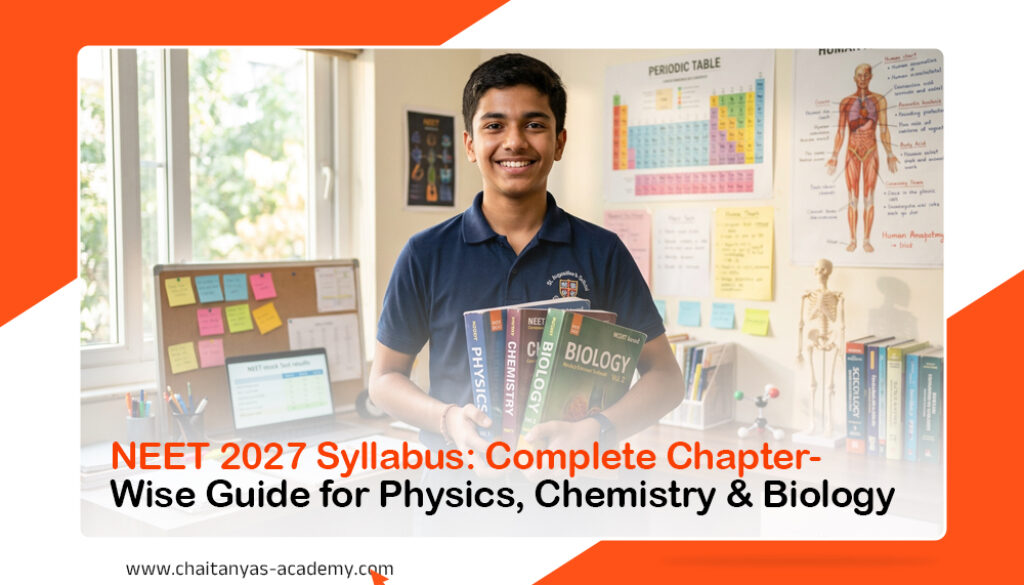
NEET 2027 Syllabus: Complete Chapter-Wise Guide for Physics, Chemistry & Biology
A clear understanding of your NEET syllabus (2027) will give you a better chance of scoring highly on the exam as you prepare for the medical entrance examination. You will understand each topic to know exactly how many questions to expect from each chapter, which subject is high priority, and you can score well throughout by familiarizing yourself with the books, chapters and subject matter using this guide to help you create a strategy for your preparation to take the NEET UG Exam (may 2027) with the analysis of thousands of previous (PYQs)
The NEET 2027 UG Exam will consist of 92 chapters (Physics, Chemistry, and Biology) with a syllabus based on the entire NCERT curriculum for Class XI & XII Science. During May 2027 NEET – UG will consist of 92 chapters (Physics, Chemistry, and Biology) and provide a breakdown of the topics along with priority/percentage assigned to those topics.
Enroll for Best NEET Coaching Classes in Maharashtra
NEET 2027 Exam Pattern Overview
Before diving into the syllabus, understanding the exam structure is crucial:
| Parameter | Details |
| Total Questions | 200 (180 to be attempted) |
| Total Marks | 720 |
| Physics | 45 questions (180 marks) |
| Chemistry | 45 questions (180 marks) |
| Biology | 90 questions (360 marks) |
| Duration | 3 hours 20 minutes |
| Question Type | MCQs with Section A (35) + Section B (15, attempt 10) |
| Medium | 13 languages including English, Hindi, Bengali |
NEET 2027 Physics Syllabus: Chapter-Wise Complete Guide
Class 11 Physics Chapters (16 Chapters)
| Chapter Number | Chapter Name | Weightage | Priority |
| 1 | Physical World | 1% | Low |
| 2 | Units and Measurements | 2% | Medium |
| 3 | Motion in a Straight Line | 4% | High |
| 4 | Motion in a Plane | 3% | High |
| 5 | Laws of Motion | 5% | Do or Die |
| 6 | Work, Energy and Power | 4% | Do or Die |
| 7 | System of Particles and Rotational Motion | 3% | Medium |
| 8 | Gravitation | 3% | High |
| 9 | Mechanical Properties of Solids | 2% | Medium |
| 10 | Mechanical Properties of Fluids | 2% | Medium |
| 11 | Thermal Properties of Matter | 2% | Medium |
| 12 | Thermodynamics | 3% | Do or Die |
| 13 | Kinetic Theory | 1% | Low |
| 14 | Oscillations | 2% | High |
| 15 | Waves | 2% | Medium |
Class 12 Physics Chapters (14 Chapters)
| Chapter Number | Chapter Name | Weightage | Priority |
| 1 | Electric Charges and Fields | 4% | Do or Die |
| 2 | Electrostatic Potential and Capacitance | 3% | High |
| 3 | Current Electricity | 5% | Do or Die |
| 4 | Moving Charges and Magnetism | 3% | High |
| 5 | Magnetism and Matter | 2% | Medium |
| 6 | Electromagnetic Induction | 3% | High |
| 7 | Alternating Current | 2% | Medium |
| 8 | Electromagnetic Waves | 1% | Low |
| 9 | Ray Optics and Optical Instruments | 5% | Do or Die |
| 10 | Wave Optics | 3% | High |
| 11 | Dual Nature of Radiation and Matter | 2% | High |
| 12 | Atoms | 2% | Medium |
| 13 | Nuclei | 2% | Medium |
| 14 | Semiconductor Electronics | 3% | Do or Die |
Top 10 High-Weightage Physics Chapters for NEET 2027
Based on PYQ analysis from 1,030+ questions:
- Laws of Motion (5%) – Fundamental concepts, Newton’s laws applications
- Current Electricity (5%) – Ohm’s law, Kirchhoff’s rules, potentiometer
- Ray Optics and Optical Instruments (5%) – Lens formula, mirror equations, microscopes
- Work, Energy and Power (4%) – Conservation principles, collision problems
- Motion in a Straight Line (4%) – Kinematics equations, graph analysis
- Electric Charges and Fields (4%) – Gauss law, Coulomb’s law applications
- Thermodynamics (3%) – Heat engines, Carnot cycle, thermodynamic processes
- Moving Charges and Magnetism (3%) – Biot-Savart law, Ampere’s circumferential law
- Electromagnetic Induction (3%) – Faraday’s laws, Lenz’s law, self-induction
- Semiconductor Electronics (3%) – Diodes, transistors, logic gates
Physics Preparation Tip: Focus on numerical problem-solving. Chapters like Current Electricity and Ray Optics consistently contribute 8-10 questions combined.
NEET 2027 Chemistry Syllabus: Chapter-Wise Complete Guide
Chemistry comprises 30 chapters divided into Physical, Inorganic, and Organic Chemistry. The subject requires memorization alongside conceptual understanding.
Class 11 Chemistry Chapters (16 Chapters)
Physical Chemistry (Class 11)
| Chapter | Name | Weightage | Priority |
| 1 | Some Basic Concepts of Chemistry | 4% | Do or Die |
| 2 | Structure of Atom | 3% | Do or Die |
| 3 | Classification of Elements & Periodicity | 2% | Medium |
| 4 | Chemical Bonding and Molecular Structure | 5% | Do or Die |
| 5 | Thermodynamics | 4% | Do or Die |
| 6 | Equilibrium | 5% | Do or Die |
| 7 | Redox Reactions | 1% | Low |
Inorganic Chemistry (Class 11)
| Chapter | Name | Weightage | Priority |
| 8 | States of Matter: Gases and Liquids | 2% | Medium |
| 9 | Organic Chemistry – Some Basic Principles | 3% | High |
| 10 | Hydrocarbons | 2% | Medium |
Note: Chapters 3, 8 combine Inorganic concepts
Class 12 Chemistry Chapters (14 Chapters)
Physical Chemistry (Class 12)
| Chapter | Name | Weightage | Priority |
| 1 | Solutions | 3% | High |
| 2 | Electrochemistry | 4% | Do or Die |
| 3 | Chemical Kinetics | 3% | High |
| 4 | Surface Chemistry | 1% | Low |
Inorganic Chemistry (Class 12)
| Chapter | Name | Weightage | Priority |
| 5 | General Principles & Isolation of Elements | 2% | Medium |
| 6 | p-Block Elements | 4% | Do or Die |
| 7 | Coordination Compounds | 5% | Do or Die |
| 8 | d and f Block Elements | 3% | High |
Organic Chemistry (Class 12)
| Chapter | Name | Weightage | Priority |
| 9 | Haloalkanes and Haloarenes | 2% | Medium |
| 10 | Alcohols, Phenols and Ethers | 3% | High |
| 11 | Aldehydes, Ketones and Carboxylic Acids | 4% | Do or Die |
| 12 | Organic Compounds Containing Nitrogen | 3% | High |
| 13 | Biomolecules | 2% | Medium |
Top 10 High-Weightage Chemistry Chapters for NEET 2027
Based on topic analysis and coaching trends:
- Chemical Bonding (5%) – VSEPR theory, bond polarity, molecular geometry
- Coordination Compounds (5%) – IUPAC naming, Werner’s theory, bonding theories
- Equilibrium (5%) – Chemical equilibrium, acid-base balance, Le Chatelier’s principle
- Some Basic Concepts of Chemistry (4%) – Stoichiometry, mole concept, percentage composition
- Thermodynamics (4%) – Enthalpy, entropy, Gibbs energy, calorimetry
- Electrochemistry (4%) – Nernst equation, cell potential, conductivity
- p-Block Elements (4%) – Group 15-18 elements, properties, compounds
- Aldehydes, Ketones and Carboxylic Acids (4%) – Reaction mechanisms, named reactions
- Structure of Atom (3%) – Quantum numbers, orbital theory, spectral lines
- Chemical Kinetics (3%) – Rate laws, order of reaction, activation energy
Chemistry Preparation Tip: NCERT Inorganic Chemistry is non-negotiable. Coordination Compounds and p-Block Elements together contribute 9% of Chemistry questions.
NEET 2027 Biology Syllabus: Chapter-Wise Complete Guide
Biology dominates NEET with 32 chapters (16 Botany + 16 Zoology) and 50% weightage. This is the most scoring section.
Class 11 Biology – Botany (8 Chapters)
| Chapter | Name | Weightage | Priority |
| 1 | The Living World | 1% | Low |
| 2 | Biological Classification | 2% | Medium |
| 3 | Plant Kingdom | 3% | High |
| 4 | Morphology of Flowering Plants | 3% | High |
| 5 | Anatomy of Flowering Plants | 2% | Medium |
| 6 | Cell – The Unit of Life | 3% | Do or Die |
| 7 | Cell Cycle and Cell Division | 2% | High |
| 8 | Photosynthesis in Higher Plants | 3% | Do or Die |
| 9 | Respiration in Higher Plants | 2% | High |
| 10 | Plant Growth and Development | 2% | Medium |
Note: Class 11 Botany has 10 chapters officially
Class 12 Biology – Botany (8 Chapters)
| Chapter | Name | Weightage | Priority |
| 11 | Sexual Reproduction in Flowering Plants | 4% | Do or Die |
| 12 | Fruit and Seed Development | 1% | Low |
| 13 | Genetics and Evolution | 8% | Do or Die |
| 14 | Molecular Basis of Inheritance | 5% | Do or Die |
| 15 | Human Health and Diseases | 2% | Medium |
| 16 | Strategies for Enhancement in Food Production | 2% | Medium |
| 17 | Microbes in Human Welfare | 1% | Low |
| 18 | Biotechnology: Principles and Processes | 3% | High |
| 19 | Biotechnology and Its Applications | 2% | Medium |
| 20 | Ecology and Environment | 4% | Do or Die |
Class 11 Biology – Zoology (8 Chapters)
| Chapter | Name | Weightage | Priority |
| 1 | Body Fluids and Circulation | 3% | High |
| 2 | Breathing and Exchange of Gases | 2% | High |
| 3 | Excretory Products and Elimination | 2% | Medium |
| 4 | Locomotion and Movement | 1% | Low |
| 5 | Neural Control and Coordination | 3% | High |
| 6 | Chemical Coordination and Integration | 2% | High |
| 7 | Human Reproduction | 4% | Do or Die |
| 8 | Reproductive Health | 2% | Medium |
Class 12 Biology – Zoology (8 Chapters)
| Chapter | Name | Weightage | Priority |
| 9 | Animal Kingdom | 3% | Do or Die |
| 10 | Structural Organisation in Animals | 2% | Medium |
| 11 | Digestion and Absorption | 2% | Medium |
| 12 | Photosynthesis (Animal context) | 0% | N/A |
| 13 | Organism and Population | 2% | Medium |
| 14 | Population Ecology | 2% | Medium |
| 15 | Ecosystem | 2% | Medium |
| 16 | Biodiversity and Conservation | 2% | Medium |
Note: Official NEET Biology has 32 chapters – 16 Botany + 16 Zoology
Top 10 High-Weightage Biology Chapters for NEET 2027
Based on 1,030 PYQs analysis:
- Genetics and Evolution (8%) – Mendel’s laws, pedigree analysis, natural selection
- Molecular Basis of Inheritance (5%) – DNA replication, transcription, PCR,基因工程
- Sexual Reproduction in Flowering Plants (4%) – Pollination, double fertilization, embryo development
- Ecology and Environment (4%) – Ecosystems, biodiversity, environmental issues
- Human Reproduction (4%) – Gametogenesis, menstrual cycle, pregnancy
- Animal Kingdom (3%) – Classification, characteristics of all 9 phyla
- Cell – The Unit of Life (3%) – Cell organelles, structure, functions
- Photosynthesis in Higher Plants (3%) – Light reaction, CAM pathway, Calvin cycle
- Plant Kingdom (3%) – Algae, bryophytes, pteridophytes, gymnosperms
- Morphology of Flowering Plants (3%) – Root, stem, leaf modifications
Biology Preparation Tip: Botany and Zoology each contribute 45 questions. Genetics alone gives 12-14 questions – master this chapter first.
Subject-Wise Chapter Count and Weightage Summary
| Subject | Total Chapters | Class 11 Chapters | Class 12 Chapters | Total Questions | Marks | Weightage |
| Physics | 30 | 16 | 14 | 45 | 180 | 25% |
| Chemistry | 30 | 16 | 14 | 45 | 180 | 25% |
| Biology | 32 | 16 | 16 | 90 | 360 | 50% |
| Total | 92 | 48 | 44 | 180 | 720 | 100% |
Biology’s 50% weightage makes it the deciding factor for top ranks.
“Do or Die” Chapters: Must-Prioritize Topics
Based on PYQ frequency analysis, these chapters are non-negotiable for 650+ scores:
Physics Do or Die (6 Chapters)
- Laws of Motion
- Current Electricity
- Ray Optics and Optical Instruments
- Work, Energy and Power
- Electric Charges and Fields
- Thermodynamics
Chemistry Do or Die (8 Chapters)
- Chemical Bonding
- Coordination Compounds
- Equilibrium
- Some Basic Concepts of Chemistry
- Thermodynamics
- Electrochemistry
- p-Block Elements
- Aldehydes, Ketones and Carboxylic Acids
Biology Do or Die (7 Chapters)
- Genetics and Evolution
- Molecular Basis of Inheritance
- Sexual Reproduction in Flowering Plants
- Ecology and Environment
- Human Reproduction
- Animal Kingdom
- Cell – The Unit of Life
NEET 2027 Preparation Strategy from Chaitanya’s Academy
Month-by-Month Plan for NEET 2027
June–July 2026 (Class 11 Foundation)
- Complete all Class 11 Physics chapters with numerical practice
- Master Chemical Bonding and Equilibrium in Chemistry
- Focus on Genetics and Cell Biology in Biology
August–September 2026 (Class 12 Start)
- Begin Class 12 Physics – prioritize Electrostatics and Optics
- Organic Chemistry foundation: Haloalkanes to Biomolecules
- Human Physiology and Reproduction in Zoology
October–December 2026 (Integration Phase)
- Mixed chapter practice (Class 11 + 12)
- 50+ mock tests with analysis
- NCERT line-by-week revision for Biology
January–April 2027 (Revision & Sprint)
- Only “Do or Die” chapters revision
- Previous 10 years PYQs (2017–2026)
- Speed improvement and accuracy enhancement
Important Resources for NEET 2027
| Resource Type | Recommendation | Purpose |
| Primary Textbook | NCERT Class 11 & 12 (All Subjects) | 95% questions from NCERT |
| Physics Reference | HC Verma + NCERT Exemplar | Conceptual depth |
| Chemistry Reference | OP Tandon (Physical) + NCERT (Inorganic) | Balanced coverage |
| Biology Reference | NCERT only + Diagram practice | 95% direct NCERT questions |
| Practice Book | NEET Previous 10 Years PYQs | Pattern familiarity |
| Mock Tests | Chaitanya’s Academy Test Series | Exam simulation |
Conclusion
The NEET syllabus has 92 chapters in Physics, Chemistry and Biology. The portion of Biology has 50% weightage. Focus on the 21 “Do or Die” chapters covering 45-50% of questions to facilitate smart examination preparation and achieve maximum results.
Chaitanya’s Academy emphasises that smart preparation is better than hard preparation. Our chapter-wise weightage list and Past Year Questions (PYQ)-based strategy have enabled thousands of students to gain admission to the best medical colleges in India. Start your NEET preparation with a clear roadmap of the syllabus and a proven method of preparation.
Are you ready to get 650+ marks in NEET 2027? Join Chaitanya Academy’s flagship NEET program and enjoy:
✅ Syllabus covered completely and prioritised
✅ 5,000+ MCQs with full explanations
✅ Weekly full-length mocks
✅ Personal performance analytics
✅ NCERT detailed Biology training
To register for this program go to: https://chaitanyas-academy.com/ .
Frequently Asked Questions (FAQs)
How many chapters are included in the NEET 2027 syllabus?
Answer: The NEET 2027 syllabus consists of 92 chapters in total, including 30 chapters in Physics, 30 chapters in Chemistry, and 32 chapters in Biology (Botany and Zoology combined).
Is NCERT enough for NEET 2027 preparation?
Answer: NCERT is the most important resource for NEET preparation, especially for Biology and Chemistry. For Physics, students should combine NCERT concepts with regular numerical practice and mock tests.
When will the NEET 2027 exam be conducted?
Answer: The official NEET 2027 exam date has not yet been announced. Based on previous trends, the examination is expected to be held in May 2027.
What is the total mark allocation for NEET 2027?
Answer: NEET 2027 will likely consist of 180 questions carrying a total of 720 marks, following the standard exam pattern.
What is the best strategy to prepare for NEET 2027?
Answer: Start with high-weightage chapters, strengthen your NCERT concepts, solve thousands of MCQs, and take regular mock tests. Consistent revision, error analysis, and expert guidance can significantly improve your NEET performance.


10 Tips to Handle Stress During NEET Preparation 2025
September 30, 2026 @ 5:33 am
[…] start by getting a clear picture of the NEET 2027 syllabus and then break it into smaller, manageable parts. Set daily or weekly goals that push you forward […]