How to Balance School, Board Exams and Competitive Exam Preparation in Class 11
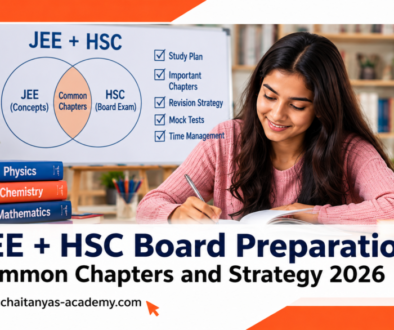
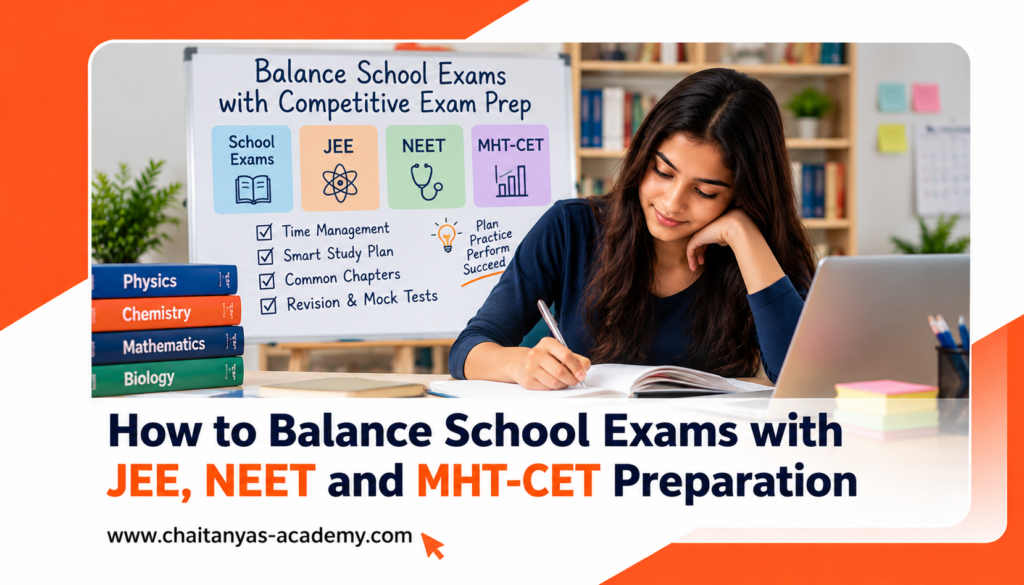
Class 11 is the year for JEE and NEET Preparation undoubtedly starts, however, this is also the year when many students become stressed due to the drastic increase in the difficulty level of the curriculum as well as due to the need to combine preparations for school studies with preparing for competitive exams. The essential thing is not to treat preparation for board exams separately from preparing for entrance exams but rather to develop a unified rather than split preparation system that serves both types of exams.
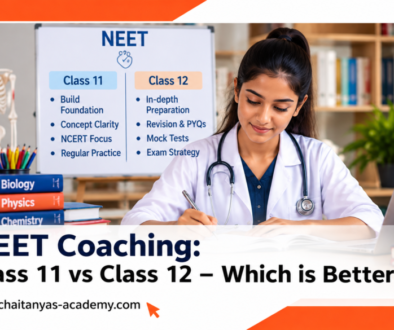
Importance of NEET & JEE coaching classes for 11th
Class 11 becomes the basis for a significant portion, which constitutes about 40% to 50% of all subjects required to pass JEE or NEET. Important concepts such as Mechanics, Laws of Motion, Bonding Theories, etc., are not only some of the most significant ones you should know for passing the exam but also make up the core knowledge for preparation for all subjects in Class 12.
Based on the curriculum for Class 11 presented by CBSE in 2025, students will have to get ready for Physics, Chemistry, and Biology tests which will contain theory papers that weigh 70 marks each and practical tests which will carry 30 marks. Therefore, one cannot ignore preparing for the board exam and he or she has to deal with board preparation from Day 1.
| Subject | Class 11 Theory Marks | Key High-Weightage Units (2025–26) |
| Physics | 70 | Kinematics (23 marks), Laws of Motion (23 marks), Properties of Bulk Matter (20 marks) |
| Chemistry | 70 | Chemical Bonding (7 marks), Thermodynamics (9 marks), Organic Chemistry Basics (11 marks) |
| Biology | 70 | Diversity of Living Organisms (15 marks), Cell Structure & Function, Human Physiology |
| Mathematics | 80 + 20 IA | Sets & Functions, Calculus Basics, Algebra |
If you ignore NEET coaching for 11th class material, you will create a backlog that will be very tough to clear in Class 12, particularly if you are studying for exams like JEE Main 2027 (which will be held on January 22, 2027) or NEET 2027.
A Practical Weekly Study Plan
The best way to study sustainably is to spend approximately 60% of your study time focused on building concepts (useful for both boards and competitive exams), 25% of your time on practicing question types from either JEE or NEET exams, and about 15% of your time preparing for board examinations.
Here is a sample weekly timetable for a student attending school and JEE coaching classes for 11th:
| Time Slot | Activity | Purpose |
| 6:00 AM – 7:00 AM | Wake up, light exercise, quick formula revision | Boosts oxygen flow; primes memory |
| 7:00 AM – 2:00 PM | School hours | Attend classes actively; use free periods to finish assignments |
| 2:00 PM – 3:30 PM | Lunch, rest, power nap | Essential for memory consolidation and burnout prevention |
| 3:30 PM – 5:30 PM | Coaching class or self-study (JEE/NEET level) | Deep dive into competitive exam concepts |
| 5:30 PM – 6:30 PM | Break: outdoor play, hobby, or walk | Prevents mental fatigue |
| 6:30 PM – 8:30 PM | Board-focused study (NCERT + answer writing) | Covers CBSE blueprint: 50% competency-based, 20% MCQs, 30% short/long answers |
| 8:30 PM – 9:15 PM | Dinner and family time | No screens; mental reset |
| 9:15 PM – 10:00 PM | Revision + error log review + next-day planning | Reinforces learning and tracks weak areas |
| 10:00 PM | Sleep | 7–8 hours is non-negotiable for retention |
On weekends, dedicate 3–4 hours to one full-length subject mock test (Physics, Chemistry, or Biology/Maths) followed by detailed analysis. Use the remaining time to review your “wrong-question notebook” and plan the next week.
How to Use NCERT for Both Boards and Entrance Exams
NCERT textbooks cover about 60–70% of JEE Main questions and are the primary source for NEET. The smartest strategy is to read each NCERT chapter twice:
- First pass (Board mode): Read line-by-line, underline definitions, and practice writing 3–5 mark answers as per CBSE expectations.
- Second pass (Competitive mode): Immediately solve 10–15 JEE/NEET-level MCQs from the same chapter to test application.
This “NCERT-first” block should be 90 minutes to 2 hours every morning or evening, depending on your coaching schedule.
Common Mistakes Class 11 Students Make
- Treating Class 11 as a “warm-up” year: Many students relax in Class 11, only to face a massive backlog in Class 12. This is the single biggest reason for drop in ranks.
- Separating boards and JEE/NEET preparation: Studying them as two different syllabi leads to duplication of effort and burnout.
- Skipping practicals and internal assessments: CBSE allocates 30 marks for practicals in Science subjects. Ignoring them can cost you a full grade.
- No error log: Not maintaining a notebook of wrong questions means you repeat the same mistakes in every mock test.
- Too much coaching and no self-study: Attending class 12 JEE coaching or NEET coaching for class 11 is helpful, but if you do not spend 2-3 hours every day studying by yourself, the material will not register in your mind.
Check Out: How to Prepare for JEE Main 2027 from Class 11: Complete Guide
Subject-Wise Tips for Class 11
Physics
Focus on Kinematics, Laws of Motion, and Work-Energy-Power. These three units alone account for over 60 marks in your board exam and are fundamental for JEE Advanced. Solve at least 20 numericals per chapter from a standard module or HC Verma.
Chemistry
Fundamentals like chemical bonding, thermodynamics, and organic chemistry should not be neglected. You must memorize all of the NCERT reactions, and also solve numericals related to Mole Concept and Equilibrium.
Biology (for NEET aspirants)
Read NCERT Biology like a novel. Every line, diagram, and example is potential NEET content. Make flashcards for Diversity, Morphology, and Human Physiology.
Mathematics (for JEE aspirants)
Do not forget about class 11 maths. Quadratic equations, sequences and series, and trigonometry will feature directly in class 12 calculus.
Read more about 70% to 90% in Science: Study and Coaching Strategies for Classes XI & XII
When to Start Full-Length Mock Tests
You do not need to take full JEE or NEET mocks in Class 11. Instead, take chapter-wise or unit-wise tests after completing each topic. Start full-length mocks only in the last 3–4 months of Class 12.
Nevertheless, when preparing for board exams, go through at least 5 previous year’s CBSE Class 11 papers two months prior to your final examinations. This way you get familiar with the 50% competency-based question pattern that has been introduced in the year 2025-26.
Check Out: Best 11th and 12th Science Coaching Classes in Pune
How to Choose the Best Coaching Institution
In case you are looking for Best Science Coaching in Classes 11 and 12, check the following points about the institution:
- Separate foundation courses available for Classes 11 and 12
- Regular doubt-solving sessions and weekly tests
- Study material that is aligned with the syllabus of CBSE and JEE/NEET
- Teachers with proven track records for best results
In cities like Pune, Baramati, Ahilya Nagar, Ranchi, etc. there are many reputed coaching institutes, but it is up to you to select the right one according to your studying technique, transportation, and financial limits.
Final Thoughts
Organizing academic courses, board examinations, and competitive tests during Class 11 is tough but doable if you have an effective plan in place with self-discipline and the right support structure around you. It is not the students who spend the maximum hours studying that become successful, but those who manage their time well and study efficiently—using NCERT texts along with practice for competitive tests, keeping an error log and taking help when required.
In Chaitanya’s Academy, we have mentored hundreds of students from Pune, Baramati, Ahilya Nagar, and Ranchi to prepare for various exams, such as JEE, NEET, and board examinations together. Backed by professionally trained teachers and proven teaching methods, our Best Science Coaching 11th & 12th will help you build a strong base from the very first day.
When you are in search of the best coaching for class 11 and 12 in science that understands the stress of preparing for the board and competitive exams, you can count on us.
Come and join the Chaitanya’s Academy family and start with us today by visiting https://chaitanyas-academy.com/ to check for our JEE coaching for class 11, NEET coaching for class 11, and integrated class 12 JEE coaching program.
Frequently Asked Questions (FAQs)
Is Class 11 very important for JEE and NEET?
Answer: Yes. Class 11 is an important part of JEE and NEET preparation because many concepts from Physics, Chemistry, Mathematics, and Biology form the foundation for Class 12 topics. Ignoring Class 11 can lead to a backlog that becomes difficult to manage later.
For how many hours should I study in Class 11?
Answer: A student can aim for around 5 to 7 hours of focused self-study each day, apart from school and coaching hours. This time can be divided between NCERT reading, problem-solving, revision, and clearing doubts.
Is it possible to prepare for JEE and NEET without attending coaching classes?
Answer: Yes, students can prepare for JEE or NEET through self-study with discipline, reliable study material, regular practice, and mock tests. A structured study plan and consistent revision are important for staying on track.
What if I wasted my Class 11 studies?
Answer: Do not panic. Start by identifying important Class 11 topics and prioritising concepts that are also connected to Class 12. Topics such as Kinematics, Chemical Bonding, and Cell Biology can be included in your recovery plan. With proper planning, regular practice, and revision, you can work towards covering the backlog.
Is it advisable to take board and JEE/NEET mock tests together?
Answer: In Class 11, focus mainly on chapter-wise and topic-wise tests. In Class 12, you can combine board preparation with full-length JEE or NEET mock tests. During the final 4 to 5 months, a planned schedule that alternates board-focused tests and entrance exam mocks can help you prepare for both.