
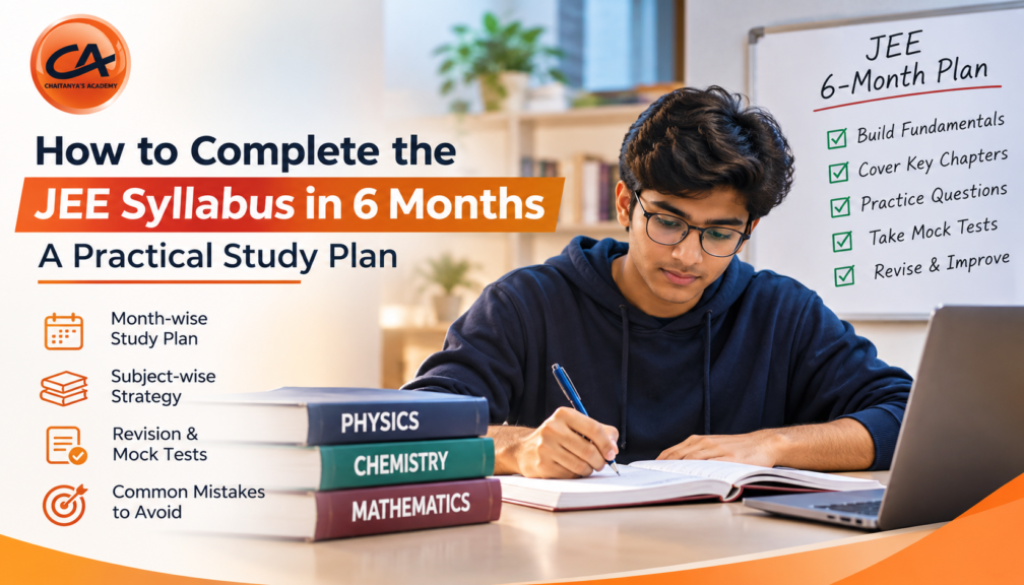
How to Complete the JEE Syllabus in 6 Months: A Practical Study Plan
Preparing for JEE Main and Advanced in just six months can feel challenging, especially if your syllabus is incomplete or you’re struggling with certain concepts. However, with a structured study plan, consistent practice, and effective time management, you can make significant progress towards your engineering entrance examination goals.
The key to success is to focus on important chapters, strengthen fundamental concepts, solve questions, and revise what you have studied. Whether you are a Class 11 or 12 student or a JEE dropper, following the right JEE preparation strategy can help you cover the syllabus systematically.
With expert academic guidance from Chaitanya’s Academy, you can focus your preparation and make it more productive.
Is It Possible to Complete the JEE Syllabus in 6 Months?
Yes, you can complete the JEE syllabus in 6 months with a well-defined timetable. Set your daily, weekly, and monthly goals. Note down the topics you have already covered and focus on the high -weightage topics to improve your overall score. Consider the following points before starting your preparation.
- Chapters you have already completed.
- Chapters that require revision and practice.
- Chapters that you have not studied yet.
Understand the JEE Main and Advanced Syllabus
Before starting your preparation, understand the syllabus and examination requirements of both JEE Main and JEE Advanced.
- JEE Main: Focuses on conceptual understanding, accuracy, speed, and application of concepts.
- JEE Advanced: Tests deeper conceptual understanding, analytical thinking, and complex problem-solving abilities.
Download the latest syllabus from the official JEE Main website and JEE Advanced website.
Six-Month JEE Preparation Strategy
A month-wise study plan can make your preparation more organised. Here is how you can divide your six months:
Month 1: Build Strong Fundamentals
- Read NCERT textbooks, especially for Chemistry.
- Understand basic Physics concepts and mathematical applications.
- Practise fundamental problems after completing every topic.
Month 2: Cover Important Chapters
Once your fundamentals are clear, start covering important chapters from the JEE syllabus.
| Important Chapters for JEE Mains | ||
| Physics | Chemistry | Maths |
| Current ElectricityModern PhysicsRotational Dynamics Thermodynamics Electrostatics. | Coordination Compoundsp-Block & Periodic Table elementsChemical BondingOrganic reactions (GOC and Carbonyl compounds) | 3D Geometry and VectorMatrices & DeterminantsCalculus (Limits, Continuity, Definite Integration, Application of Derivatives)Sequence & Series |
Month 3: Strengthen Concepts and Practise Questions
- Start solving previous years’ JEE questions.
- Practise numerical and application-based problems.
- Attempt chapter-wise and topic-wise tests.
- Analyse your mistakes after every test.
Month 4: Complete Remaining Topics
- Focus on the remaining chapters.
- Practise mixed-concept questions.
- Solve previous years’ question papers.
- Take regular mock tests to evaluate your preparation.
Month 5: Revision and Mock Test
- Revise all completed chapters.
- Attempt full-length JEE Main mock tests.
- Practise JEE Advanced papers if targeting both examinations.
- Analyse incorrect and unanswered questions.
- Improve your speed and question-selection strategy.
Month 6: Final Revision and Exam Preparation
- Revise short notes, formulas, reactions, and important concepts.
- Solve full-length mock tests in an exam-like environment.
- Focus on your weak and frequently incorrect topics.
- Practise time management and accuracy.
- Maintain a healthy sleep schedule and avoid unnecessary stress.
Subject-Wise JEE Preparation Strategy for Physics, Chemistry, and Mathematics
Each JEE subject requires a different preparation approach. Therefore, divide your study time according to the nature and difficulty of each subject.
Physics
Physics requires conceptual clarity and regular numerical practice.
- Understand concepts before memorising formulas.
- Practise numerical problems from different difficulty levels.
- Focus on Mechanics, Electrodynamics, Optics, and Modern Physics.
- Revise important formulas regularly.
- Solve previous years’ questions to understand examination patterns.
Chemistry
Chemistry requires a combination of conceptual understanding, memory, and numerical practice.
- Study NCERT thoroughly, particularly for Inorganic Chemistry.
- Practise reaction mechanisms and named reactions in Organic Chemistry.
- Understand formulas and numerical applications in Physical Chemistry.
- Prepare concise notes for important reactions and concepts.
- Revise regularly to improve retention.
Mathematics
Mathematics requires consistent practice and strong problem-solving skills.
- Focus on Algebra, Calculus, Coordinate Geometry, and Trigonometry.
- Practise a variety of questions from each chapter.
- Learn different approaches to solving numerical problems.
- Improve calculation speed and accuracy.
- Maintain a separate notebook for challenging problems.
Common Mistakes to Avoid During JEE Preparation
While preparing for JEE in six months, avoid these common mistakes:
- Ignoring NCERT: These books are essential to build strong fundamentals and boost your score in chemistry.
- Studying without a timetable: Set daily and weekly targets to monitor your progress.
- Avoiding mock tests: Regular tests help improve speed, accuracy, and time management.
- Neglecting revision: Without revision, it becomes difficult to retain concepts.
- Using too many study resources: Follow limited, reliable resources instead of switching between multiple books.
- Ignoring weak subjects: Maintain a balanced preparation strategy for Physics, Chemistry, and Mathematics.
How Chaitanya’s Academy Can Help Students Prepare for JEE
Preparing for JEE requires more than completing the syllabus. Students also need conceptual clarity, consistent practice, performance evaluation, and proper academic guidance.
Chaitanya’s Academy supports JEE aspirants with structured coaching and subject-wise preparation for Classes 11 and 12. With guidance from experienced faculty, students can strengthen their fundamentals, understand challenging concepts, and improve their problem-solving abilities.
The academy’s JEE coaching classes can help students follow a systematic learning approach for JEE Main and Advanced.
With the right guidance, regular practice, and a disciplined study routine, students can make their six-month preparation journey more focused and effective.
Conclusion
Completing the JEE syllabus in six months requires a clear roadmap, consistent effort, and the right preparation strategy. Divide your syllabus into monthly targets, strengthen your concepts, practise questions regularly, and dedicate sufficient time to revision and mock tests.
Remember, every study session brings you one step closer to your engineering goals. With structured preparation and academic support from Chaitanya’s Academy, you can make your JEE preparation more organised and work towards achieving your desired results.
Frequently Asked Questions (FAQs)
Can I complete the JEE syllabus in 6 months?
Yes, you can cover the JEE syllabus in six months with a structured timetable, consistent study, and regular revision. Your strategy should depend on your current preparation level.
How many hours should I study daily for JEE?
Students should aim for approximately 6–8 focused hours of self-study, depending on their school and coaching schedule. The quality of study matters more than the number of hours.
Is NCERT enough for JEE preparation?
NCERT is particularly important for Chemistry and helps build fundamental concepts. However, JEE preparation also requires additional problem-solving practice, previous-year questions, and suitable reference material.
When should I start attempting JEE mock tests?
You can begin with chapter-wise tests once you complete individual topics. Gradually introduce full-length mock tests as you cover more of the syllabus.