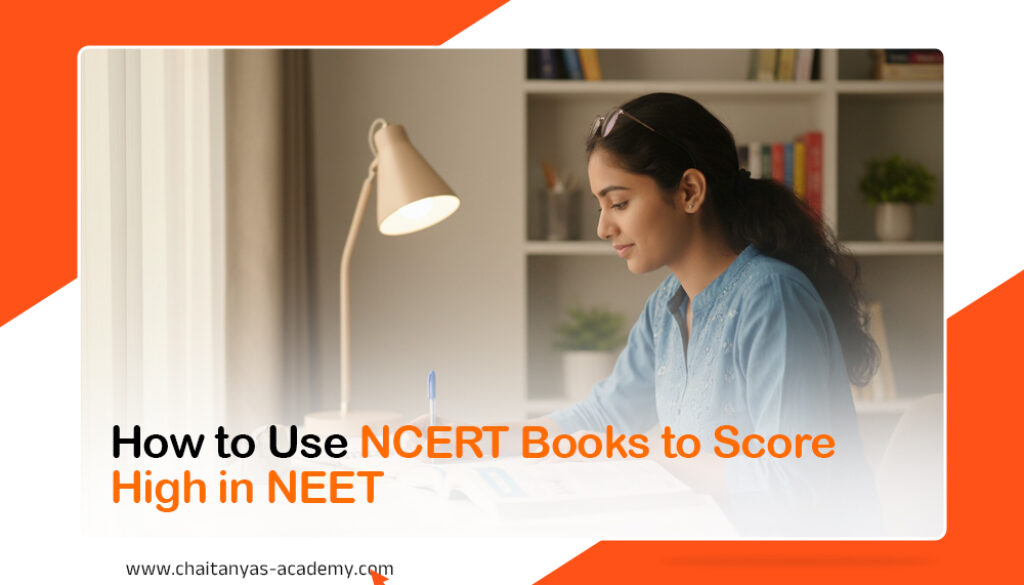
How to Use NCERT Books to Score High in NEET
NCERT books are considered to be one of the best study materials for the NEET exam, as 75 to 80% of the NEET exam paper is based on the concepts of the NCERT. Using them in the right way can improve your chances of selection in the NEET exam. We are all aware that the NEET exam is one of the most challenging exams for medical aspirants, using the best books for NEET preparation makes a huge difference in how effectively you understand concepts and practise questions.
Role of NCERT Books in NEET Preparation
NCERT books are easy and simple to understand, as most of the concepts in the books are given alongside examples from real life. For Biology, the NCERT books are considered as the ‘Bible’ as more than 80% of the exam paper is based on the NCERT books. However, for Physics & Chemistry, the NCERT is not enough, as both subjects require thorough practice of the numericals from the reference books.
Here are a few points to determine the role of NCERT books in NEET preparation:
- Covers the Major Portion in the Exam Paper: Around 70-80% of the NEET exam paper is from the NCERT books.
- Simple and Accurate Content: NCERT explains concepts in simple words, reducing confusion. Unlike large guidebooks, it solely includes exam-relevant information.
- Focus on Definitions and Terms: The NEET frequently evaluates identical phrases, definitions, and terms from the NCERT. If you memorize them, you will be able to effortlessly answer factual inquiries.
- Diagrams and figures: NCERT diagrams are very significant. Many questions are directly based on NCERT figures, particularly in Biology.
- Time-Saving Resource: NCERT helps students avoid wasting time on unimportant topics. Reading the NCERT fully promotes good exam alignment.
- Foundation for Reference Books: Understanding reference books is tough unless you have mastered the NCERT. NCERT serves as the primary level of preparation.
NCERT Books for NEET 2026 Preparation
Biology
To prepare for NEET biology, it is advisable to use the NCERT books as follows:
- Read the book several times, line by line, to remember the terms and concepts, as 80-85% of the NEET biology questions come from the NCERT for classes 11th & 12th.
- Focus on definitions, tables, and diagrams. Small facts from side boxes and highlights are also often asked in the exams.
- Solve the back exercise to understand the application-based questions on the facts given in the chapters.
Read More: NEET Biology: How to Memorise Long Chapters Faster
Chemistry
To prepare for the NEET Chemistry, use the NCERT books as follows:
- Inorganic Chemistry: NCERT is completely sufficient. Questions about the periodic table, chemical bonding, and coordination compounds are directly derived from the NCERT.
- Organic Chemistry: The most significant aspects of organic chemistry are reaction mechanisms, named reactions, and the examples provided by NCERT. Practising all of the images and exercises will help you prepare.
- Physical Chemistry: NCERT thoroughly covers all of the formulas and basic concepts, but there aren’t enough practice questions. Question banks are required for additional practice.
Physics
Use NCERT books as follows:
- The NCERT books can only clear your concepts and help you learn the definitions and formula derivations.
- Solve the questions given as examples and the back exercise to understand the application of the formula.
- Use reference books such as HC Verma- Fundamentals of Physics Vol.1 & 2 and DC Pandey to practise varied difficulty numericals.
- Solve past 10 years’ question papers to get an insight into the types of questions.
Check Out: NEET Physics Syllabus 2025, Important Chapters, and Weightage
Step-by-Step Guide to Study NCERT for NEET
- Begin with a New NCERT Textbook
- Do not rely on old, underlined, or highlighted books that have been previously used.
- Make a fresh start. Maintain a single set of clean NCERT texts for all three subjects.
- Why? Because you will highlight your own key elements, which adds to retention.
- Read every line, literally.
NEET questions might arise from the most unexpected sentences or references. So:
- Read each line slowly and carefully.
- Avoid skipping examples, tables, diagrams, or even captions.
- Pay attention to the definitions, vocabulary, and labels.
- One word, particularly in biology, has the power to convey different meanings.
- Highlight and create margin notes.
While reading, utilize a colour code to mark important points:
- Yellow represents definitions and facts.
- Blue indicates examples and exceptions.
- Green indicates diagrams or crucial figures.
- In the margins, include short summaries or keywords. This will help with revision.
- Create Chapter-Wise Notes
- Take short notes on significant themes in your own words.
- Create a list of formulas, mechanisms, and procedures.
- Create rapid revision tables or flowcharts.
Once your notes are ready, you should prioritise the high-scoring chapters in NEET 2026 during revision so that important topics are easier to revisit.
- Solve NCERT-based questions.
Reading alone is not sufficient. You must practice questions for each chapter:
- Use NCERT Exemplar Problems (particularly in Chemistry and Physics).
- Try NCERT-based MCQ books (such as MTG’s NCERT at Your Fingertips).
- Solve previous year NEET questions in that chapter.
- If you can successfully answer 90% of NCERT-based questions, you have a good concept.
Once you’re hitting that 90% accuracy mark, the next challenge is maintaining it under the pressure of the clock. It’s normal to feel a bit slow at first, so once you’ve mastered the NCERT content, the final step is learning how to improve your accuracy and speed for NEET day to stay sharp when every second counts.
- Revise wisely and frequently.
The NCERT should be rewritten more than once.
- Apply the 1-3-7-15 rule.
- First revision: after one day.
- Second: After three days.
- Third: After seven days.
- Fourth: After 15 days.
Use margin notes, diagrams, and visualization for quick revision.
Final Tip to Use NCERT Books to Boost NEET Preparation
- NCERT is your daily dose. Reading daily can boost your NEET performance
- Focus on diagrams, keywords, botanical and zoological names, and important terms.
- Make your own notes and diagrams for better understanding.
- Solve PYQs and MCQs to improve your speed and accuracy.
- Revise regularly to improve your retention power, not just before the exam.
- NCERT will never let you down in the NEET exam preparation process.
Conclusion
Preparing from the NCERT books can become a game-changer for your exam preparation. Building a strong conceptual understanding is the motto of the NEET preparation, as most of the questions are based on the fundamentals. At Chaitnaya Academy, our key focus is on the NCERT books, and our study material is also designed around these books. Join hands with us to ensure your success in the NEET exam.
Frequently Asked Questions
Are the NCERT books for NEET preparation enough to get a score of 600+?
Answer: Definitely, using NCERT for NEET preparation can take your score to 600+, as most of the NEET Biology and Chemistry questions are based on the NCERT book concepts.
Is NCERT Biology sufficient for NEET 2026?
Answer:Yes, NCERT Biology textbooks are more than enough for NEET. Approximately 70-80% of NEET Biology questions are derived either from or inspired by the NCERT. Students should also read the NCERT Biology books several times in preparation for the NEET exam.
How to merge NCERT books with reference books for NEET preparation?
Answer:In the initial phase, use NCERT books to understand the concepts, and add on the reference books to practice more questions and different types of problems for exam preparation. Do not forget to revise the NCERT books from time to time for better retention.