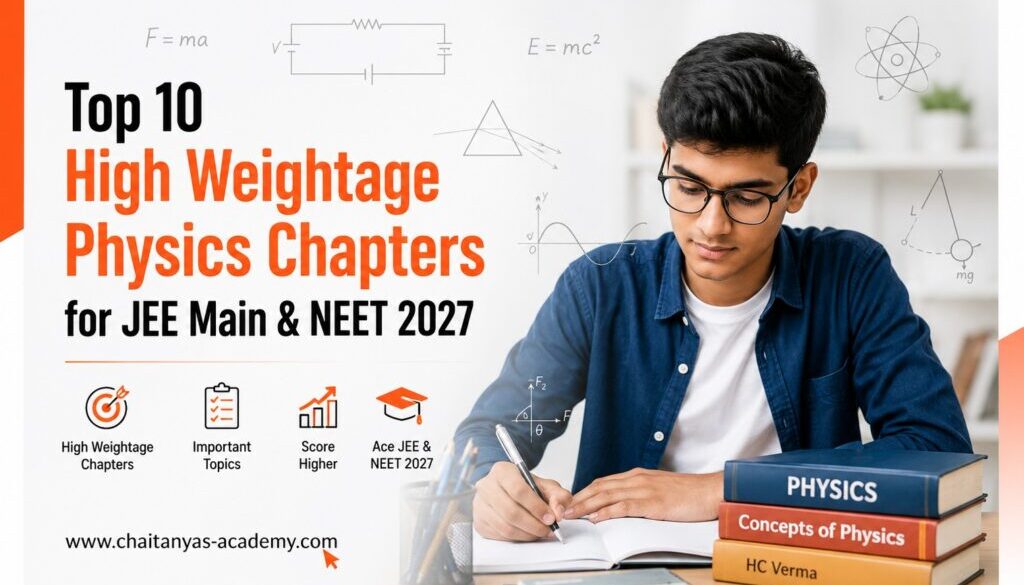
Top 10 High-Weightage Physics Chapters for JEE Main & NEET 2027
To do well in Physics exams, the students must focus on areas where most questions are likely to appear. As far as JEE Main 2027 is concerned, recent weightage analysis has repeatedly indicated that Mechanics, Electrostatics, Current Electricity, Optics, and Modern Physics are among the most priority areas, while for NEET Physics, Modern Physics, Mechanics, Electricity, Magnetism, Optics, Thermodynamics, and Semiconductor chapters remain on the top.
The students making their preparations with Chaitanya’s Academy will find the above list useful, as it will clear their minds and enable them to take actions in the planned manner. The key to efficient preparation is not the belief that “the more chapters studied the better,” but rather being able to handle the range of chapters and master them in the proper sequence, and also get sufficient practice to be able to do well in the exam.
Why These Chapters Matter
The value of high-weightage chapters is not only in their high frequency of appearance in exams: these chapters are also likely to give students’ direct and simple questions when understood properly.
That means the best strategy is simple:
- Finish the high-yield chapters first.
- Revise formula-heavy areas every week.
- Solve mixed questions, not only chapter-wise easy sets.
- Keep a mistake notebook for repeated errors.
Top 10 chapters table
| Rank | Chapter | JEE Main value | NEET value | Why it is a smart priority |
| 1 | Modern Physics | Very high | Very high | Fast scoring, concept-light, repeated question type |
| 2 | Current Electricity | Very high | High | Formula-based and highly revision-friendly |
| 3 | Electrostatics | Very high | High | Regularly asked and strong for conceptual MCQs |
| 4 | Magnetic Effects of Current and Magnetism | Very high | High | Common in both exams and ideal for repeated practice |
| 5 | Ray Optics and Optical Instruments | Very high | High | High return with formula clarity and diagram-based questions |
| 6 | Semiconductor Electronics | High | High | Short, scoring, and frequently repeated |
| 7 | Mechanics | Very high | High | Foundation chapter group that influences many other topics |
| 8 | Thermodynamics | High | High | Strong conceptual and formula-based scoring zone |
| 9 | Electromagnetic Induction and Alternating Current | High | High | Often gives direct questions if formulas are solid |
| 10 | Waves / Wave Optics | High | High | Reliable for direct questions and easy revision gains |
JEE Main focus
In JEE Main, physics scoring heavily relies on the topics of Mechanics, Electrostatics, Magnetism, and Optics, which have highest weightage according to the recent weightage analysis.
A sharp JEE Main Physics strategy should look like this:
- First finish Modern Physics and Current Electricity.
- Then move to Electrostatics and Magnetism.
- Keep Optics and EMI/AC in the active revision loop.
- Use Mechanics as the base layer for problem-solving strength.
NEET focus
NEET physics, on the other hand, needs the students to stick to their NCERT books and assimilate the knowledge. Furthermore, the most sought-after topics are also Modern Physics, Electricity, Magnetism, Thermodynamics, Semiconductor Electronics, and Mechanics.
The NEET approach should be:
- Master the most scoring and repeatedly asked chapters first.
- Revise theory in short cycles.
- Solve lots of direct MCQs.
- Spend extra time on formula retention and silly-mistake control.
Smart study order
Not all high-weightage chapters should be studied in the same sequence. A smart sequence helps students gain confidence early while building harder chapters on top of a strong base.
A strong order is:
- Modern Physics.
- Current Electricity.
- Electrostatics.
- Semiconductor Electronics.
- Ray Optics.
- Magnetism.
- EMI and AC.
- Thermodynamics.
- Waves and Wave Optics.
- Mechanics.
Why this order works:
- It starts with faster scoring topics.
- It builds momentum before the heavier problem-solving chapters.
- It keeps revision simple and repeatable.
- It protects confidence while the syllabus expands.
Weekly conversion plan
A chapter is not “done” when the theory is read once. It is done when the student can solve questions without hesitation.
Use this weekly cycle:
- Monday to Wednesday: Learn and solve one high-weightage chapter.
- Thursday: Mixed MCQs from two chapters.
- Friday: Formula revision and error log.
- Saturday: Mini test.
- Sunday: Full revision of the week’s topics.
What students usually miss
A lot of students let their physics preparation go to waste by spending a lot of time on low returns, safe topics. They also tend to fall into the trap of thinking that they need to finish every chapter of the syllabus before they start revising.
Avoid these traps:
- Studying chapters in random order.
- Ignoring formula revision.
- Solving too few mixed questions.
- Skipping test analysis.
- Treating high-weightage chapters as “easy,” which they are not.
Why Chaitanya’s Academy fits
Chaitanya’s Academy can position this strategy as a practical, results-first Physics roadmap rather than a generic chapter list. The strongest message is that success comes from a focused sequence, expert guidance, and a repeatable practice system that converts high-weightage chapters into marks.
For aspirants, that means a coaching environment that does not just teach Physics — it trains score-making habits. That is what makes a marketed, student-first preparation message feel real.
Final takeaway
Honestly the best Physics prep for JEE Main and NEET 2027 isn’t about chasing every single chapter with the same amount of energy or something like that. It’s more about fixing which chapters give the top marks , doing them first, revising them again and again, and slowly turning “tests” into something normal, one chapter at a time.
If a student can actually nail the ten chapters above with proper practice, then Physics stops feeling like a fear factor. Instead it turns into a real scoring advantage, like quietly by itself.
Frequently Asked Questions (FAQs)
Which Physics chapters are most important for JEE Main and NEET 2027?
Answer: Modern Physics, Current Electricity, Electrostatics, Magnetism, Optics, Mechanics, Thermodynamics, and Semiconductor Electronics are among the highest-weightage chapters for both JEE Main and NEET 2027.
Should students study high-weightage Physics chapters first?
Answer: Yes. Starting with high-weightage chapters helps build confidence, improves scoring potential early, and creates a strong foundation for the remaining syllabus.
Is the Physics preparation strategy the same for JEE Main and NEET?
Answer: No. JEE Main requires deeper problem-solving and analytical skills, whereas NEET focuses more on conceptual clarity, formula-based questions, and accuracy.
How many times should these chapters be revised?
Answer: Students should aim for at least 3–4 complete revision cycles, supported by regular mock tests, formula revision, and error analysis.
Can students score well by focusing only on high-weightage chapters?
Answer: Focusing on high-weightage chapters can significantly improve scores, but students should not ignore the remaining syllabus. A balanced preparation strategy offers the best chance of achieving a high rank.


JEE Main & JEE Advanced Study Guide: Expert Tips
September 8, 2026 @ 1:22 pm
[…] Check Out: Top 10 High-Weightage Physics Chapters for JEE Main & NEET 2027 […]