
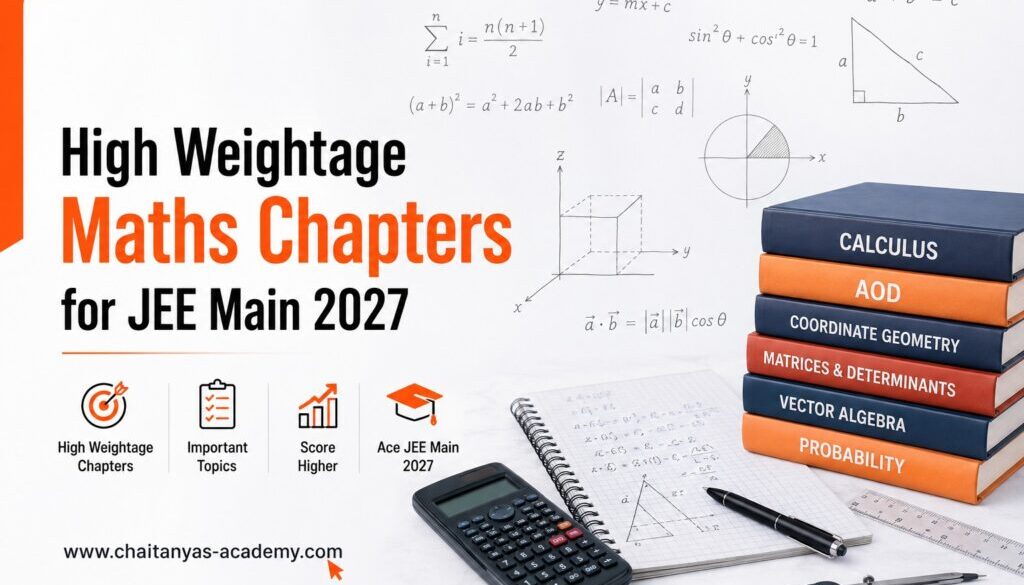
Top 15 High-Weightage Mathematics Chapters for JEE Main 2027
The students preparing for the JEE 2027 exam will agree that Mathematics is just the subject where right chapter selection can help them save time and improve their scores. Analysis of trends in chapters shows that certain following chapters keep appearing, with Calculus, Coordinate Geometry, Algebra, and Vector-3D being crucially important chapters.
Enroll Chaitanya Academy for IIT JEE Coaching Classes in Maharashtra
Why does it make sense to focus on these chapters?
JEE Main does not specify chapter-wise weightage, hence it will be wrong to say that the list provides any guarantees; however recent trend analysis shows that certain chapters are very popular in any of the exams.
So, in order to get a maximum score, it is important to master a few chapters first before dealing with the rest of the syllabus, that is exactly how the intelligent JEE aspirants approach Math and leave behind tons of other formulas.
Read More about JEE Main Math Mastery: 6 Key Topics and Tips for Success
Top 15 chapter table
| Rank | Chapter | Approx. weightage / trend | Why it matters most | Must-do subtopics |
| 1 | Integral Calculus | 11%+ | One of the most repeated areas in Maths | Definite integral, properties, area under curves, substitution, by parts |
| 2 | Coordinate Geometry | 15%+ | Highest overall chapter cluster in most trend studies | Straight lines, circles, parabola, ellipse, hyperbola |
| 3 | Algebra: Complex Numbers & Quadratic Equations | 8% approx. | Regularly asked and relatively scoring | Modulus-argument, roots, nature of roots, relations between roots and coefficients |
| 4 | Limits, Continuity & Differentiability | 7%+ | Core Calculus foundation, appears every year | Limits, continuity, derivative basics, standard limits |
| 5 | Sequence and Series | 7%+ | Short, formula-heavy, and high ROI | AP, GP, sums, sigma notation, AM-GM basics |
| 6 | Sets, Relations & Functions | 7%+ | Easy marks when concepts are clear | Domain-range, types of relations, composition, inverse functions |
| 7 | Matrices and Determinants | 7% approx. | Very scoring and less time-consuming | Properties, inverse, adjoint, linear equations |
| 8 | Statistics and Probability | 6%–7% | Direct question source with manageable difficulty | Mean, variance, SD, basic probability, Bayes theorem |
| 9 | Three-Dimensional Geometry | 6%+ | A frequent direct-question chapter | Direction cosines, lines in space, shortest distance, angle between lines |
| 10 | Trigonometry | 6%+ | Supports many other chapters too | Identities, equations, inverse trigonometry, graphs |
| 11 | Vector Algebra | 5%+ | Formula-based and quick to revise | Dot product, cross product, projection, vector components |
| 12 | Differential Equations | 4%+ | Small chapter, solid scoring potential | Order-degree, separable variables, linear equations |
| 13 | Permutations and Combinations | 4%+ | Often asked in direct or mixed form | Counting principles, arrangements, selections |
| 14 | Binomial Theorem | 3%–4% | Small but consistent | General term, middle term, coefficient problems |
| 15 | Conic Sections | 6%–8% overall within coordinate geometry | Especially useful if you want high-scoring geometry | Parabola, ellipse, hyperbola, latus rectum, standard equations |
What the numbers say
Analyzing the latest JEE Main Mathematics trends reveals that some chapters have their presence established in almost every exam cycle. Coordinate Geometry, Calculus, Algebra, and Vector-3D are the four most important chapters, as they are an essential part of the Mathematics paper.
Quick snapshot
| Area | Approx. share / trend | What it means for students |
| Calculus | 30% | The single biggest scoring zone in Maths. |
| Algebra | 25% | High repetition, formula-heavy, very important. |
| Coordinate Geometry | 20% | One of the most stable and predictable areas. |
| Vector + 3D | 10% to 15% combined in many analyses | Small-looking, but very reliable for direct questions. |
| Remaining chapters | 20% to 25% | Still important, but not the first place to start. |
Recent PYQ-based analyses also show that Coordinate Geometry alone can contribute around 13.8%, while Integral Calculus is around 9.2%, Limits, Continuity & Differentiability around 8.3%, and 3D Geometry around 8.3%. Matrices, P&C, Sets-Functions, Complex Numbers, Probability, and Vector Algebra also sit in the strong middle band of repeat value.
Chapter-wise weightage table
| Rank | Chapter | Approx. weightage / trend | Why it matters |
| 1 | Coordinate Geometry | 13.8% | Very frequent, formula-based, and scoring. |
| 2 | Integral Calculus | 9.2% | Questions often come from standard properties and formulas. |
| 3 | Limits, Continuity & Differentiability | 8.3% | Core calculus foundation and a frequent question source. |
| 4 | Three-Dimensional Geometry | 8.3% | Direct and repeat-friendly if the basics are clear. |
| 5 | Matrices & Determinants | 7.3% | Quick marks, especially if practiced well. |
| 6 | Permutations & Combinations | 7.3% | Useful in algebra and probability-type thinking. |
| 7 | Sets, Relations & Functions | 7.3% | Small, important, and concept-driven. |
| 8 | Complex Numbers & Quadratic Equations | 6.4% | One of the most dependable algebra chapters. |
| 9 | Statistics & Probability | 6.4% | High-scoring if formulas and basics are strong. |
| 10 | Vector Algebra | 6.4% | Direct and practical, often paired with 3D. |
| 11 | Differential Equations | 5.5% | Small chapter, easy to revise, good for quick scoring. |
| 12 | Sequences & Series | 5.5% | Formula-heavy and commonly asked. |
| 13 | Binomial Theorem | 4.6% | Compact chapter with repeat-style questions. |
| 14 | Trigonometry | 3.7% | Slightly lower weightage, but still very useful. |
Class 11 vs Class 12 split
The distribution of the JEE Main Mathematics syllabus is not uniform between Classes XI and XII. Based on most recent analyses, Class XII topics seem to dominate the paper barely but Class XI chapters also contribute tremendously and support Class XII chapters.
| Class | Important chapters | Why they matter |
| Class 11 | Sets, Relations & Functions, Complex Numbers, Quadratic Equations, P&C, Binomial Theorem, Sequences & Series, Trigonometry, Coordinate Geometry | These chapters build the foundation and keep producing direct questions. |
| Class 12 | Limits, Continuity & Differentiability, Application of Derivatives, Integrals, Differential Equations, Matrices, Determinants, Vectors, 3D Geometry, Probability | These are the major score-builders in JEE Main Maths. |
Why this topic matters
The key to succeeding in JEE Main Maths isn’t studying each chapter in the same depth. The test usually presents a clear pattern, as several chapters are responsible for a majority of the questions, with other chapters contributing only a limited share of questions. According to new chapter-wise studies, it seems that the chapters focused on coordinate geometry, calculus, algebra, vector algebra, and 3D geometry remain among the most scoring areas.
This is the reason for the chapter-priority approach being useful since students learn what the frequent topics are and spend their time on the things that work best, accomplish more, and gain more confidence.
To summarize the above, this topic is important because it answers several questions:
- What chapter shall I study first?
- What topics give the most marks in relation to time spent?
- How can I avoid wasting useful time on the chapters that are not giving any return?
How to study smartly
1) Start with the highest-return chapters
Focus first on:
- Coordinate Geometry.
- Integral Calculus.
- Limits, Continuity and Differentiability.
- Matrices and Determinants.
- Vector Algebra.
- Probability.
These chapters give a strong balance of weightage, repeat value, and scoring potential.engineering.
2) Build a formula-first revision system
- Make a short formula sheet for each chapter.
- Revise these sheets every 2–3 days.
- Add tricky identities, standard results, and common question patterns.
3) Solve PYQs chapter-wise
- Do previous year questions after completing each chapter.
- Track which concepts repeat.
- Mark your weak spots and revise them separately.
4) Keep a second-priority list
After the top chapters, move to:
- Binomial Theorem.
- Permutations and Combinations.
- Sequence and Series.
- Differential Equations.
- Statistics.
These chapters may look smaller, but they often become easy marks if the basics are clear.
Final word
At Chaitanya’s Academy, we always tell students one thing: JEE Main Maths becomes manageable when you stop treating it like one giant subject and start treating it like a smart chapter game. Focus on these 15 chapters first, revise them well, and you’ll already be building a very strong score base for JEE Main 2027.
Frequently Asked Questions (FAQs)
What is the most important Mathematics chapter for JEE Main 2027?
Answer: Integral Calculus and Coordinate Geometry are among the most important areas based on recent paper trends. Algebra and other Calculus topics also contribute significantly to the JEE Main Mathematics section.
Can I skip low-weightage chapters?
Answer: Students should not completely skip any chapter. However, low-weightage topics can be covered later after completing high-priority chapters to maximize preparation efficiency.
Is the JEE Main Mathematics syllabus mostly based on Class 12?
Answer: Class 12 topics contribute significantly to the JEE Main Mathematics paper, but Class 11 topics are also important. Algebra, Trigonometry, and Coordinate Geometry can provide scoring opportunities from the Class 11 syllabus.
Are JEE Main Mathematics chapter-wise weightages officially released?
Answer: No. NTA does not officially publish chapter-wise weightage for Mathematics. The commonly cited weightages are based on analysis of previous JEE Main papers and observed trends.
What should I do after completing the important Mathematics chapters?
Answer: After completing the important chapters, solve chapter-wise previous years’ questions, mixed problem sets, and full-length mock tests. Regular practice and analysis can improve speed, accuracy, and overall exam performance.

JEE Main 2027 Preparation from Class 11 | Chaitanya’s Academy
October 14, 2026 @ 12:37 pm
[…] Read more about Top 15 High-Weightage Mathematics Chapters for JEE Main 2027 […]
JEE Main & JEE Advanced Study Guide: Expert Tips
October 14, 2026 @ 12:42 pm
[…] chapters will naturally need more practice than others. The high-weightage Mathematics chapters for JEE Main, for instance, deserve enough question practice for you to get comfortable with different ways a […]