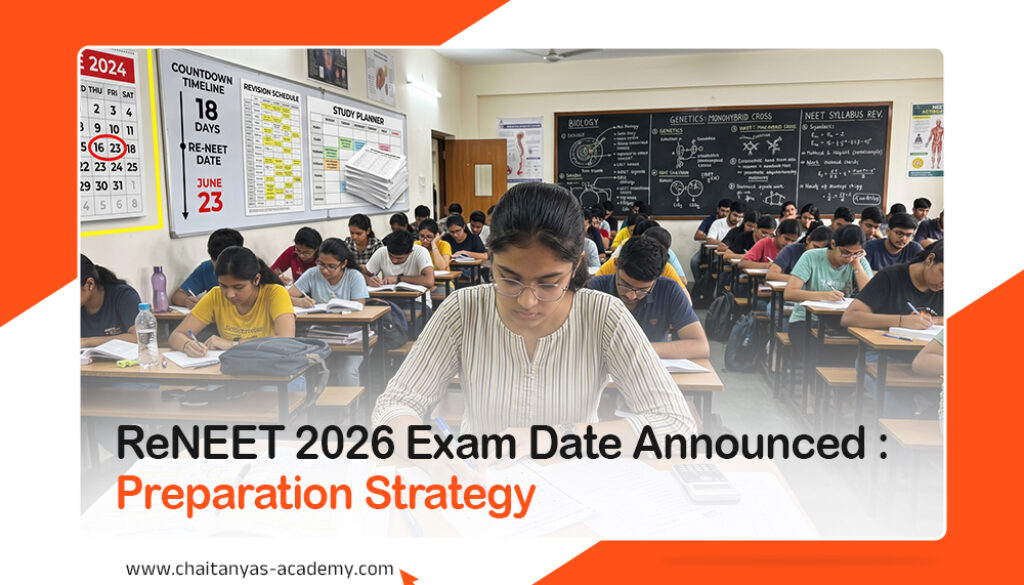
ReNEET 2026 Exam Date Announced: Preparation Strategy Guide
The announcement of ReNEET 2026 has changed the routine of lakhs of medical aspirants across the country once again.
Many students had already stepped out of exam mode after appearing for NEET earlier this year. Some had slowed down preparation, some were waiting for counselling updates, and others were simply trying to recover from months of pressure and exhaustion.
Then came the re-exam announcement.
Now the challenge is not just academic preparation. It is about getting mentally back on track without burning out completely.
This phase can either damage confidence or become an opportunity to improve scores. A lot depends on how students use the next few weeks.
The good part is that students are not starting from zero anymore. Most aspirants have already completed the syllabus once, solved mock tests, and experienced the actual exam environment. The focus now should not be on studying everything again from scratch. It should be on smart revision, better accuracy, and stronger exam control.
Check Out: Best Medical Colleges in India Through NEET 2026
The Biggest Mistake Students Are Making Right Now
After hearing about ReNEET, many students immediately started:
- making unrealistic timetables,
- joining multiple crash courses,
- buying extra books,
- or studying for 14–15 hours continuously.
That usually backfires.
At this stage, overloading yourself creates more confusion than improvement.
Students preparing for NEET have already spent months covering:
- Biology concepts,
- Physics numericals,
- Chemistry reactions,
- mock papers,
- and NCERT revision.
The problem now is not lack of knowledge. The real challenge is:
- consistency,
- confidence,
- and staying mentally balanced.
First Understand What ReNEET Really Means
A re-exam changes the emotional side of preparation more than the academic side.
Students now fall into three common groups:
| Student Type | Common Situation |
| Confident Students | Want to improve score further |
| Average Scorers | See this as a second opportunity |
| Mentally Exhausted Students | Struggling to restart preparation |
Understanding which category you fall into helps you plan realistically.
Trying to copy someone else’s routine usually creates unnecessary stress.
Stop Treating Every Day Like an Emergency
One major problem after the ReNEET announcement is panic studying.
Students suddenly begin:
- sleeping less,
- studying nonstop,
- avoiding breaks,
- and constantly comparing preparation with friends.
That approach rarely works for long.
NEET preparation is already mentally demanding. A re-exam increases emotional pressure even more. If students continue studying in panic mode every day, burnout becomes unavoidable.
A calmer and more controlled strategy works far better right now.
The Best ReNEET 2026 Preparation Strategy
1. Go Back to NCERT Again
This sounds basic, but it still works.
A huge number of NEET questions continue to come directly from NCERT concepts, especially in Biology and Chemistry.
Students should revise:
- Biology diagrams,
- important definitions,
- reactions,
- exceptions,
- and tables carefully.
Instead of reading ten different notes, revise one trusted source properly.
2. Don’t Ignore Physics Revision
Many students spend all their time on Biology and forget Physics revision after the exam gap.
That becomes risky.
Physics requires continuous practice because:
- formulas fade quickly,
- speed reduces,
- and calculation mistakes increase after long breaks.
Students should solve:
- formula-based questions,
- mixed-topic numericals,
- and timed practice sets regularly.
Even one hour of Physics revision daily can help maintain momentum.
3. Mock Tests Matter More Than New Theory
At this stage, students should spend more time solving papers than collecting material.
Mock tests help students:
- regain exam rhythm,
- improve concentration,
- rebuild confidence,
- and manage time pressure.
Many students lose marks not because they lack preparation, but because they panic inside the exam hall.
That improves only through practice.
How Often Should Students Give Mock Tests?
Students do not need three mocks every day.
A practical approach works better.
| Preparation Stage | Suggested Mock Frequency |
| Initial Restart Phase | 2–3 mocks weekly |
| Final 2 Weeks | Alternate-day mocks |
| Final Week | Controlled revision + selected mocks |
The goal is improvement, not exhaustion.
After every mock test, students should analyse:
- silly mistakes,
- time management,
- weak chapters,
- and question selection.
That analysis is often more valuable than the test itself.
Biology Can Decide Your Rank
Most NEET toppers usually build their score through strong Biology accuracy.
Students should focus on:
- NCERT line-by-line revision,
- diagrams,
- scientific names,
- genetics,
- ecology,
- and human physiology.
Biology revision should happen daily, even if for a shorter duration.
Repeated revision improves retention naturally.
Chemistry Needs Smart Revision
Chemistry becomes easier when students divide it properly.
Physical Chemistry
Needs:
- formula practice,
- numericals,
- and concept clarity.
Organic Chemistry
Needs:
- reaction flow understanding,
- named reactions,
- and revision consistency.
Inorganic Chemistry
Needs:
- memorisation,
- NCERT reading,
- and repeated revision.
Students often ignore Inorganic revision because it feels boring. But direct questions from NCERT can make a huge difference in scores.
Students Need to Protect Their Mental Energy
This part matters more than many students realise.
After the re-exam announcement, social media became filled with:
- rumours,
- fake paper discussions,
- unrealistic study routines,
- and comparison culture.
Students constantly watching:
- “AIR 1 strategy videos”
- or “18-hour study routine” content
usually end up feeling worse mentally.
Preparation improves when students focus on their own progress instead of competing online every hour.
Sleep Is Not a Waste of Time
One of the worst habits students develop during exam stress is cutting sleep.
Lack of sleep directly affects:
- memory,
- concentration,
- reaction speed,
- and decision-making.
A student sleeping properly for 7 hours usually performs better than someone studying half-asleep for 15 hours.
The brain also needs recovery time after months of preparation.
What Students Should Avoid Before ReNEET
Avoid:
- changing books repeatedly,
- joining random crash courses,
- solving extremely difficult questions daily,
- comparing scores constantly,
- and studying without breaks.
These things increase stress without improving performance much.
Why Revision Is More Important Than New Learning
At this stage, revision gives better results than starting fresh chapters.
Students often make the mistake of:
- running behind untouched topics,
- while forgetting already prepared chapters.
That lowers overall accuracy.
A strong grip over 80–85% syllabus usually performs better than weak preparation across 100%.
Time Management During the Exam
A lot of students know concepts but lose marks because they mismanage time inside the exam hall.
Some common mistakes:
- spending too long on difficult Physics questions,
- panicking after one tough section,
- rushing Biology,
- or making OMR filling errors.
Mock practice helps students build better exam control.
Simple habits matter:
- keeping calm,
- moving ahead after difficult questions,
- and maintaining speed without panic.
Parents Need to Understand the Pressure Too
ReNEET preparation is stressful not just academically, but emotionally.
Students are already carrying:
- fear of competition,
- uncertainty,
- pressure about ranks,
- and career expectations.
Constant reminders about:
- marks,
- relatives,
- or “wasted time”
usually make things harder mentally.
Students perform better when the environment around them feels stable and supportive.
Why Structured Guidance Helps During ReNEET Preparation
Many students struggle not because they are weak academically, but because they lose direction during stressful phases.
A proper coaching environment helps students:
- stay disciplined,
- revise systematically,
- practise regularly,
- and avoid confusion.
Guidance becomes especially important after unexpected situations like re-exams.
For students preparing seriously for medical entrance exams, Chaitanya’s Academy provides structured NEET preparation support, revision planning, mock test practice, and academic mentoring designed to help aspirants stay focused during competitive exam preparation.
Final Thoughts
ReNEET 2026 has definitely disrupted the routine of students across the country. There is frustration, fatigue, and pressure — and that is understandable.
But the next few weeks should not be spent in panic.
Students who stay calm, revise consistently, practice regularly, and protect their mental balance will place themselves in a much stronger position before the exam.
This phase is no longer about completing everything perfectly.
It is about staying steady when everyone else is losing focus.
Frequently Asked Questions (FAQs)
What is the ReNEET 2026 exam date?
Answer: ReNEET UG 2026 is expected to be conducted on 21 June 2026.
Should students start new books before ReNEET?
Answer: No, students should focus more on revision, NCERT concepts, and mock test practice instead of starting new study materials.
How many mock tests should students take weekly?
Answer: Most students benefit from taking 2–3 quality mock tests every week along with proper analysis.
Is NCERT enough for Biology revision?
Answer: Yes, NCERT books remain the most important and reliable source for NEET Biology preparation and revision.
How can students avoid burnout during preparation?
Answer: Students should maintain balanced study hours, take proper sleep and breaks, and follow a realistic revision strategy to avoid burnout.