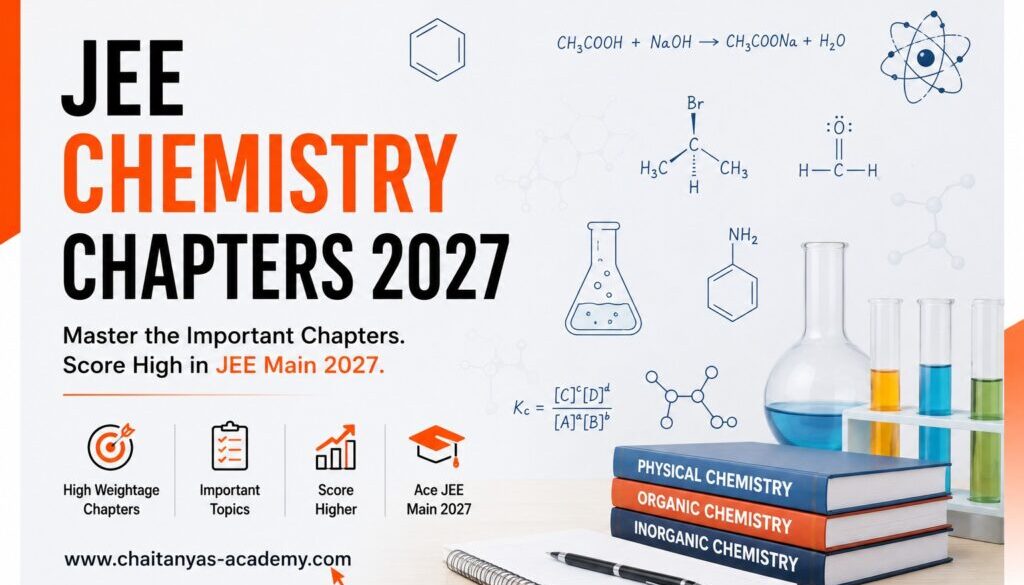
Top 10 Important JEE Chemistry Chapters for 2027
If striving for a top score in JEE Main 2027, Chemistry is your quickest way to achieve a high mark if appropriately prepared. This is unlike Physics and Maths in that JEE Chemistry chapters allow for intelligent study. In contrast, personalized study, NCERT-based principles, a predictable pattern, and Chemistry chapters responsible for the majority (65-70%) of questions on the exam produce advanced results in JEE Chemistry.
Using the information obtained through the analysis of trends in 2023-2026 and 2027 exam data, we identified 10 JEE Chemistry Chapters that can raise your scores by more than 40 points if you learn them correctly.
How Chemistry Will Help You Succeed in JEE Main 2027
It is important to clarify that JEE Chemistry topics are not about excessive problem-solving skills, but about accuracy and pattern recognition as well as clarity of NCERT materials.
As far as Organic Chemistry is concerned, it represents 28-36% of the exam (7-9 questions).
Physical Chemistry includes concepts such as Thermodynamics and Electrochemistry, the topics of Physical Chemistry being highly repeatable from year to year.
The topic of Inorganic Chemistry deals with Coordination Compounds and contributes around 8-12% to the final score.
The 10 JEE Chemistry weightage chapters 2027
Here’s the JEE Chemistry weightage shortlist—ranked by expected marks, question frequency, and scoring potential.
| Rank | Chapter | Class | Expected Marks | Weightage % | Priority |
| 1 | Coordination Compounds | 12 | ~9 | 7.3% | ⭐⭐⭐ |
| 2 | Atomic Structure | 11 | ~8 | 6.5% | ⭐⭐⭐ |
| 3 | Chemical Bonding & Molecular Structure | 11 | ~8 | 6.5% | ⭐⭐⭐ |
| 4 | Redox Reactions & Electrochemistry | 12 | ~8 | 6.5% | ⭐⭐⭐ |
| 5 | General Organic Chemistry (GOC) | 11 | ~7 | 5.6% | ⭐⭐⭐ |
| 6 | Biomolecules | 12 | ~7 | 5.6% | ⭐⭐ |
| 7 | Chemical Thermodynamics | 11 | ~7 | 5.6% | ⭐⭐⭐ |
| 8 | Equilibrium | 11 | ~7 | 5.6% | ⭐⭐⭐ |
| 9 | Organic Compounds Containing Oxygen | 12 | ~7 | 5.6% | ⭐⭐⭐ |
| 10 | d- & f-Block Elements | 12 | ~6 | 4.8% | ⭐⭐ |
JEE Chemistry important chapters
1. Coordination Compounds (Class 12) – The Inorganic Goldmine
- Why it matters: Consistently the highest-weightage Inorganic chapter (8.27% in 5-year analysis).
- Key topics: IUPAC nomenclature, Werner’s theory, crystal field theory, isomerism, magnetic properties.
- 2027 trend: 18–22 questions across sessions.
- Scoring tip: Direct NCERT-based questions. Memorize color, geometry, and hybridization tables.
Struggling with coordination chemistry mechanisms? Join Chaitanya’s Academy’s IIT-JEE Classes in Pune—where Inorganic Chemistry becomes your strongest subject.
2. Atomic Structure (Class 11) – The Fundamental Principle of Physical Chemistry
- Why you should care: 6.5% weightage in exam, ~8 marks expected from this chapter.
- Main topics: Bohr’s model, quantum numbers, electronic configuration, Heisenberg uncertainty principle and de Broglie’s equation.
- Expected trend in 2027: 10-11 questions.
- Scoring tip: Numericals regarding energy, wavelength and orbital diagrams should be mastered.
3. Chemical Bonding and Molecular Structure (Class 11) – Conceptual Understanding Equals Marks Without Struggle
- Why you should care: 5.05-6.6% weightage.
- Main topics: VBT, MOT, hybridization, dipole moment, hydrogen bonding and Fajan’s rules.
- Expected trend in 2027: 8-14 questions (may be combined with periodicity).
- Scoring tip: Get good at bond order, magnetic nature and geometry predictions.
4. Redox Reactions and Electrochemistry (Class 12) – The Numerical King of the Subject
- Why you should care: 6.07-6.5% combined weightage.
- Main topics: Nernst equation, conductivity, galvanic cells, Faraday’s laws and EMF calculations.
- Expected trend in 2027: 14-23 questions (Electrochemistry+Redox).
- Scoring tip: Solve 5-10 numericals daily. Having a formula sheet is non-negotiable.
Want a formula-driven Electrochemistry masterclass? Enroll in JEE Classes in Baramati at Chaitanya’s Academy—where every concept is backed by 100+ solved PYQs.
5. General Organic Chemistry (GOC) – Importance of GOC
- Why learn GOC: 5.6 – 6.29% marks
- Students must study: IUPAC nomenclature, isomerism, and electronic effects (resonance and hyperconjugation).
- Important for 2027: 20 questions in the exam (basic concepts).
- Tips: Understand carbocation stability and nucleophile/electrophile behavior.
6. Biomolecules (Class 12) – Low effort but high reward JEE Chemistry Chapters
- Why learn biomolecules: 4.42 -5.6% marks.
- Topics studied: Carbohydrates, proteins, amino acids and vitamins, and nucleic acids.
- Important for 2027: 11 questions in the exam.
- Tip: 90% NCERT-based.
7. Chemical Thermodynamics (Class 11) – The Physical Chemistry Anchor
- Why it matters: 5.05–6.56% weightage.
Key topics: First and second laws, enthalpy, entropy, Gibbs free energy, Hess’s law.
2027 trend: 15 questions.
Scoring tip: Numericals on ΔG, ΔH, and spontaneity are repeat performers.
8. Equilibrium (Class 11) – Key Ideas
- Importance: 5.25-5.47% importance
- Critical Aspects: Le Chatelier’s principle, the ionic equilibrium, wH, buffer solutions, solubility product
- Trend in 2027: 10-17 queries
- Advice for Success: Ionic equilibrium carries greater points as compared to chemical equilibrium.
9. Organic Materials with Oxygen (Class 12) – The Reaction Center
- Importance: 5.29-5.95% importance
- Critical Aspects: Alcohols, phenols, ethers, aldehydes, ketones, carboxylic acids
- Trend in 2027: 15-18 queries (more precisely Aldehydes – Ketones – Carboxylic Acids)
- Advice for Success: Remember the reactions.
10. d-block and f-block Elements (Class 12) – The Shortcut for Inorganics
- Importance: 4.69-5.25% importance
- Critical Aspects: Transformational metals, lanthanides, actinides, oxidation numbers, color, magnetic properties
- Trend in 2027: 9-15 queries
- Advice for Success: Pay attention to trends and deviations from these rules.
How to Use This JEE Main Chemistry List for Maximum Impact
Don’t just read, act. Here’s a kind of 4-step game plan for JEE Chemistry Chapters:
1) Prioritize
Give about 60% of your Chemistry time to the top 5 chapters first, don’t overthink it.
2) PYQ Drill
Do a full practice loop: solve 5 years of JEE Main questions for each chapter. Careers360 and PW both have free PDFs, so use them instead of waiting.
3) NCERT First
For Inorganic and Organic Chemistry, read NCERT line-by-line first before you jump into any reference books. This part matters a lot, honestly.
4) Mock Test Integration
Take 2 complete Chemistry mocks every week. While you attempt them, focus on speed as well as correctness, especially in the high-weightage zones.
Time-Saver (Important)
These 10 chapters can usually be wrapped up in 6–8 weeks with 2 hours per day. That’s a lot , like 40+ marks locked in before you even touch low-yield topics.
Ready to Turn Chemistry Into Your Rank-Booster?
At Chaitanya’s Academy, we don’t just teach Chemistry—we engineer scores. Our JEE Main 2027 batch is built around high-weightage JEE Chemistry Chapters, with:
- Chapter-wise PYQ marathons (2019–2026)
- NCERT-plus reference material for Organic and Inorganic
- Weekly mock tests with detailed performance analytics
- Doubt-clearing sessions by IITian faculty
Limited seats for JEE Main 2027! Join the best science coaching for 11th & 12th in Pune and Baramati. Visit chaitanyas-academy.com or call us today.
Final Word: JEE Chemistry 2027 Is Your Rank Multiplier
In JEE Main 2027, Chemistry isn’t optional—it’s optional to ignore. With 10 smart chapters, you can lock in 40–50 marks before the exam even begins.
Start today. Master these JEE Chemistry chapters. And watch your percentile climb.
Frequently Asked Questions (FAQs)
In order to do well in Chemistry for JEE Main 2027, which Chemistry topics should I concentrate on?
Answer: Make sure you study Coordination Compounds, Structure of Atoms, Chemical Bonding, Electrochemistry, General Organic Chemistry, and Biomolecules. You should also consider Chemical Thermodynamics, Equilibrium, Organic Compounds Containing Oxygen, and d- and f-Block Elements, as these topics have had significant weightage in recent years. Based on the 2023–2026 exam trends, these chapters can account for around 65% of the Chemistry section, giving you approximately 16–18 questions.
Can I rely only on NCERT textbooks to study the important Chemistry chapters?
Answer: For Inorganic and Organic Chemistry, NCERT is highly important, as many questions are directly or indirectly based on it, especially from topics such as Coordination Compounds, Biomolecules, and General Organic Chemistry. However, for Physical Chemistry topics like Thermodynamics, Electrochemistry, and Equilibrium, you should supplement NCERT with numerical practice, previous years’ questions, and quality reference or coaching material.
Is it possible to get a score of 80+ in Chemistry without studying the less important chapters?
Answer: Yes, you can build a strong Chemistry score by mastering the 10–12 high-priority chapters and thoroughly practising previous years’ questions. However, relying only on selected chapters may limit your maximum score. For better results, complete the important chapters first and then cover the remaining topics as time permits. With focused preparation, you can aim for a strong score in Chemistry.
What is the ideal time duration to study these important chapters?
Answer: You can study the first five priority areas—Coordination Compounds, Structure of Atoms, Chemical Bonding, Electrochemistry, and General Organic Chemistry—for around 2–3 hours daily over two weeks. The remaining important chapters can be covered by dedicating approximately 1.5–2 hours daily for another 10 days. Overall, completing and revising these important chapters may take around 6–8 weeks, depending on your current preparation level and practice speed.
Are Chapters from Class 11 of Chemistry important for the JEE Main exam in 2027?
Answer: Yes, Class 11 Chemistry chapters are important for JEE Main 2027. Topics such as Atomic Structure, Chemical Bonding, Thermodynamics, and Equilibrium can contribute significantly to the Chemistry section. Therefore, students should not skip Class 11 concepts and should strengthen these chapters along with their Class 12 preparation.


JEE Main & JEE Advanced Study Guide: Expert Tips
September 8, 2026 @ 1:18 pm
[…] Read More about Top 10 Important JEE Chemistry Chapters for 2027 […]
JEE Main 2027 Preparation from Class 11 | Chaitanya’s Academy
September 16, 2026 @ 5:56 am
[…] Check Out: Top 10 Important JEE Chemistry Chapters for 2027 […]
How to Prepare for IIT JEE 2028 from Class 11? Full Guide - Chaitanyas Academy Blog
September 21, 2026 @ 11:32 am
[…] asking you to think differently, Chemistry concepts go deeper as you cover core topics like the JEE Chemistry chapters 2027 syllabus demands more commitment, Maths demands much more practice than before. Add school, […]
How Mock Tests Can Boost Your JEE Score?
September 30, 2026 @ 5:36 am
[…] can boost your score considerably by strengthening your concepts and giving extra attention to the important JEE Chemistry chapters. Solve easy to medium difficulty level questions based on the NCERT […]